
Introduction
When OpenAI shipped Advanced Data Analysis inside ChatGPT, it didn’t just add a feature. It killed a category. Dozens of “AI-powered data analysis” startups that had raised pre-seed and seed rounds suddenly had no reason to exist. Their product was now a tab inside a competitor’s free tier.
This wasn’t bad luck. It was predictable.
If your startup’s value proposition is “we do X, but with AI,” and the AI provider can ship X natively in a quarterly update, you were never building a business. You were building a proof of concept with a Stripe integration.
The hard truth most AI founders are avoiding: building on top of GPT or Claude is not a strategy. It’s a starting point. And the window between starting point and commoditization is shorter than anyone wants to admit.
The API Layer Is Not a Moat
Let’s be direct about what most AI wrapper products actually are.
You’re taking a foundation model, writing system prompts that constrain its behavior, adding a UI that makes it feel purpose-built, and charging for the output. The underlying intelligence is rented. You own none of the weights. You have no influence over what the model learns next.
That’s not inherently a death sentence. Plenty of durable businesses are built on infrastructure they don’t own. But those businesses built something proprietary on top — data assets, network effects, switching costs — that made the underlying commodity irrelevant.
The question isn’t whether you’re using an API. The question is: what have you built that the API provider can’t replicate with a system prompt?
For most AI wrappers right now, the honest answer is nothing.
Prompt Engineering Is Not IP
A lot of founders believe their prompt engineering is a competitive advantage. It isn’t.
Prompts are text. They get leaked, reverse-engineered, and — more importantly — made redundant when the next model version handles your use case natively. OpenAI and Anthropic employ the best prompt engineers on the planet. They built the model. When they decide your workflow is worth shipping as a native feature, your system prompt becomes a relic.
The same logic applies to UX polish. Good design gets you early adopters. It doesn’t create switching costs at scale.
The “First Mover” Clock Runs Faster Here
In traditional SaaS, being first gives you 12–24 months to accumulate data, deepen integrations, and build institutional lock-in before competitors catch up.
In AI, model capabilities compound quarterly. A complex multi-step workflow that requires sophisticated orchestration today might be a single API call in six months. You don’t have two years to build a moat. You might have one product cycle.
What Actually Creates Defensibility in AI
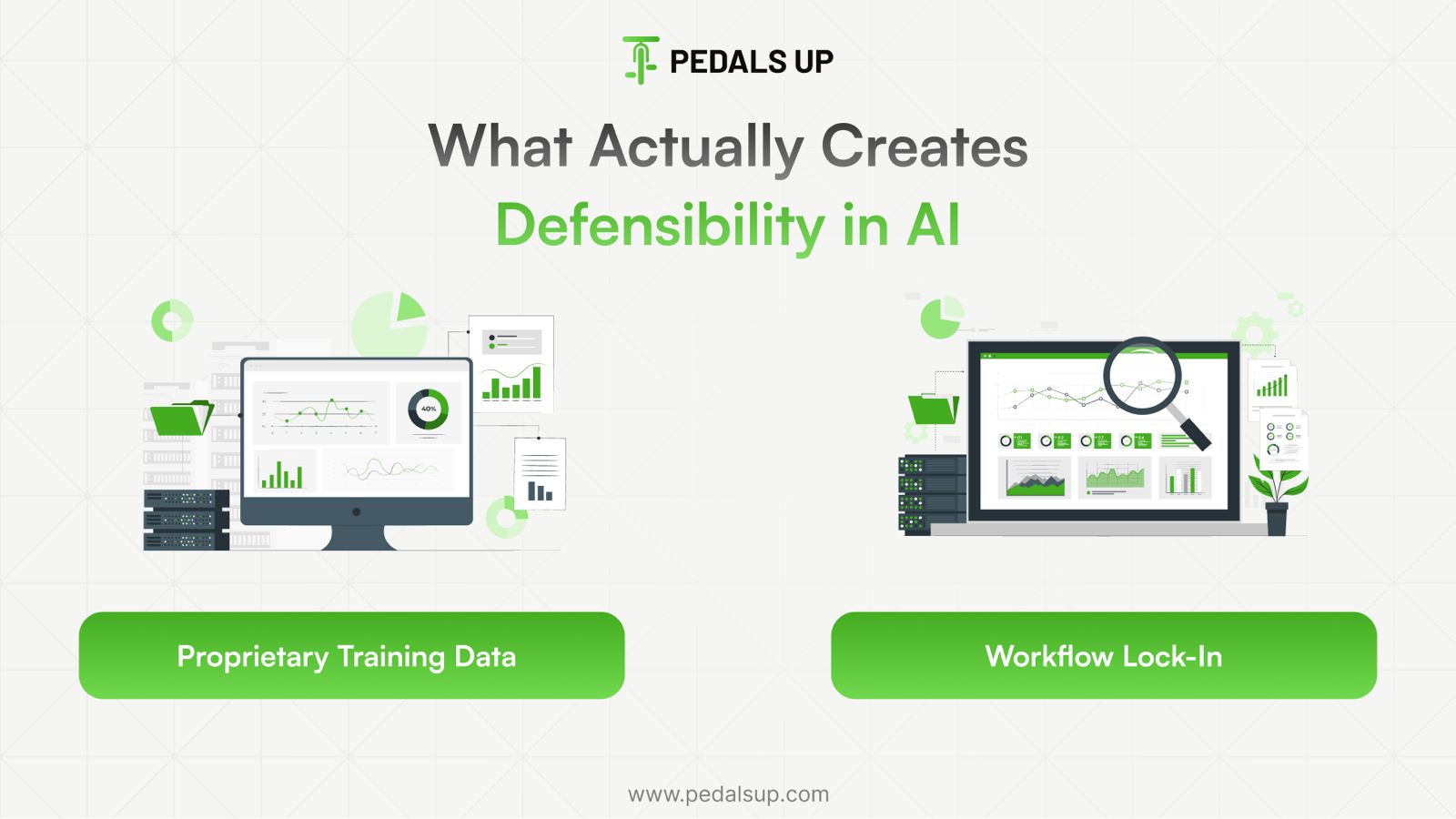
There are two structural advantages that hold up over time. Everything else is temporary.
1. Proprietary Training Data
This is the most durable moat and the hardest to build which is exactly why it’s worth building.
If you have access to data nobody else can replicate — because you generated it, licensed it exclusively, or engineered a feedback loop to collect it — you can fine-tune models that outperform generic APIs on your specific task. No amount of prompt engineering catches up to that.
The clearest example is vertical AI in regulated industries. A company with ten years of de-identified clinical notes, diagnostic patterns, and treatment outcomes can build a model that no consumer API will match for clinical decision support. The data is the product. The model is just the interface.
But this doesn’t require healthcare-scale datasets. It requires intentionality from day one.
Every AI product generates signal: what outputs users accept, what they edit, what they reject, what they come back to. Most startups treat this as logging. The ones building moats treat it as their most valuable engineering asset.
If you’re not capturing structured feedback data right now — not thumbs up/down, but granular behavioral signal — you’re leaving your moat unbuilt.
2. Workflow Lock-In
If proprietary data is the slow play, workflow lock-in is how you buy time to build it.
This isn’t about features. It’s about becoming structurally embedded in how a team operates.
There’s a meaningful difference between an AI tool that “helps you write sales emails” and one that integrates with your CRM, understands your sales methodology, knows your prospect history, and drafts follow-ups that match the rep’s documented communication style and the deal stage. The first one is a tab you close when a better one launches. The second one is something your sales team would notice — operationally — if it disappeared tomorrow.
Workflow lock-in comes from three things: deep integrations into existing systems, institutional memory that accumulates over time, and the retraining cost of switching. When your product is embedded in daily operations — when removing it means reconfiguring connected systems and rebuilding team habits — you’ve created switching cost that has nothing to do with model quality.
The Flywheel Both Create
The strongest AI companies combine both. Workflow depth drives data collection. Data improves model performance. Better outputs increase adoption. More adoption generates more data.
This is what GitHub did with Copilot — the product gets better the more it sees your codebase, your patterns, your team’s conventions. It’s what Salesforce is building with Einstein. It’s what Notion AI is attempting with document history as context. They’re not just adding AI features. They’re building data collection instruments.
The Architectural Decisions That Determine Your Fate
Most founders make the wrong call here because they optimize for shipping speed over asset accumulation. Both matter. But only one compounds.
Design your data schema before you optimize your prompts. Before you spend another week tuning outputs, answer this: how are you capturing what users do with those outputs? Structured behavioral data — edits, rejections, acceptance patterns — is your training dataset for six months from now.
Go narrow before you go broad. A horizontal “AI writing tool” collects generic data. An AI tool for insurance underwriting collects domain-specific acceptance patterns, risk assessment edits, and regulatory language preferences. The narrower your vertical, the faster your data becomes proprietary. Niche is not a limitation — it’s the strategy.
Build integrations, not just features. Every API integration you ship increases switching cost. Every standalone feature ships to a customer who can replace you next quarter. When evaluating what to build next, ask: does this make us easier to remove, or harder?
Put fine-tuning on your roadmap now. You don’t need to fine-tune today. But you need to be collecting the data so that when the generic API starts underperforming — or when a competitor shows up with a domain-specific model — you have something to train on. Retrofitting this infrastructure later is expensive.
If you’re making these architecture decisions and want a technical team that’s built production AI systems with defensibility in mind, this is exactly the kind of problem we work through at Pedals Up.
Where Most Founders Are Getting This Wrong
The mistake isn’t building on APIs. That’s pragmatic. The mistake is treating the API layer as the product strategy.
There’s also a capital allocation problem worth naming. Many AI startups spend disproportionate engineering time on model selection, prompt tuning, and inference optimization — activities that feel technical and move metrics in demos. Data infrastructure, feedback pipelines, and integration depth are less impressive to talk about. They’re also the only things that will matter in 18 months.
There’s one diagnostic question worth sitting with: if the model you’re building on doubled in capability tomorrow, would your business get stronger or weaker?
If the answer is weaker — because your differentiation depended on working around the model’s limitations — you have a structural problem. If the answer is stronger — because better model outputs flow through your proprietary data layer and deepen your workflow integration — you’re building something real.
For a grounded view of where foundation model capabilities are heading, the Stanford AI Index Report is one of the more honest assessments available. It’s useful context when making 12-month product bets.
Conclusion
Most AI startups are not building companies. They’re building features that happen to have their own pricing page — for now.
The ones that will survive the next two years of model improvements are doing something specific: they’re treating data collection as a core product strategy, not an afterthought. They’re going narrow to accumulate proprietary signal faster. They’re embedding deeply into workflows so that switching costs are real, not imagined.
The model is a commodity. The context you build around it doesn’t have to be.
That’s the only insight that matters here. Everything else is execution.
Build an AI Product That Compounds — Not One That Expires
If you’re thinking seriously about data architecture, fine-tuning strategy, or engineering the kind of workflow depth that creates real defensibility — that’s the work we do at Pedals Up.