
Introduction
Most teams that come to a blockchain development agency already have a product idea. Some have a whitepaper. A few have investor interest. Almost none of them have asked the one question that actually matters first:
Does this problem actually need a blockchain?
That question is not cynicism. It is the difference between building something that creates real value and spending eight months on infrastructure that a well-designed database could have handled in eight days.
Blockchain app development services are real, valuable, and increasingly mature. But the category is also littered with projects that confused the technology with the strategy. This guide is written for founders, CTOs, and product leaders who want to make a clear-eyed decision about whether and how to build on blockchain, and what to expect from the development process when they do.
What Blockchain App Development Services Actually Cover
When a company says it offers blockchain app development services, the term is broad. It can mean anything from deploying a simple smart contract to building a full-scale decentralized application with its own token economy, governance layer, and cross-chain compatibility.
Here is what serious blockchain development work actually includes:
Smart contract development and auditing. This is the code that runs autonomously on the blockchain. Writing it is one thing. Making it secure is another. A single flaw in a smart contract can be exploited, and unlike a backend bug, you often cannot patch it after deployment. Audit cycles are not optional, they are part of the build cost.
Blockchain selection and architecture decisions. Ethereum, Solana, Polygon, Avalanche, Hyperledger, and others each have different tradeoffs around speed, cost, decentralization, and developer tooling. The wrong choice at the architecture stage creates problems that are expensive to undo later.
Wallet integration and key management. Most users are not comfortable managing private keys. Abstracting that complexity without compromising security is one of the harder UX problems in the space. How you handle this shapes who your product is actually accessible to.
Tokenomics and on-chain logic design. If your product involves tokens, incentives, or governance, the economic design is not a separate concern from the technical development. They are deeply intertwined, and mistakes in token design tend to surface only after launch.
Off-chain and on-chain data coordination. Blockchains are not good databases. They are slow, expensive to write to, and publicly visible. Most real-world blockchain applications combine on-chain logic with off-chain data systems. Getting that split right is often where the actual engineering challenge lives.
Where Most Blockchain Projects Break Down
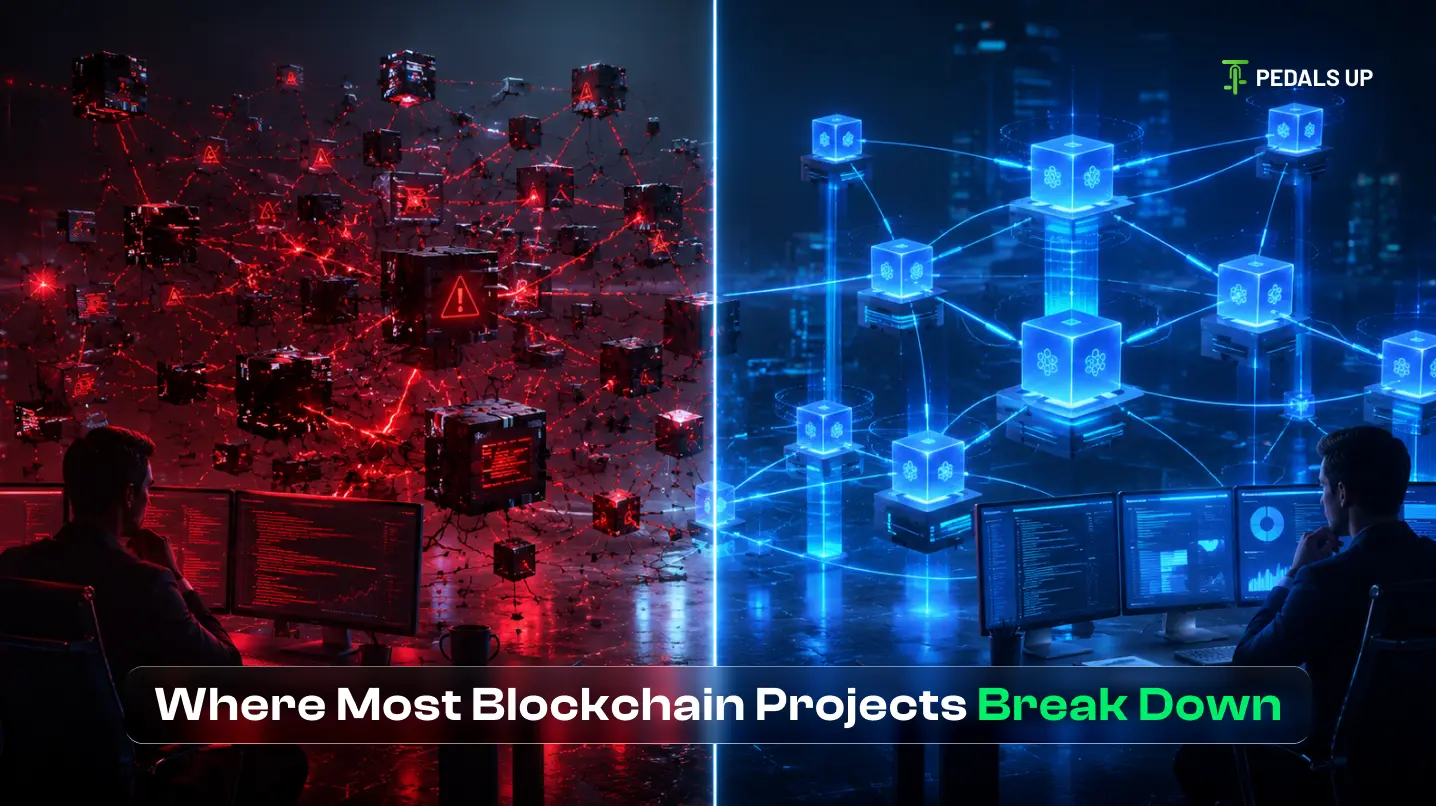
This is the part most development agencies will not tell you upfront, because it sometimes means talking a potential client out of a blockchain project.
Building on blockchain when centralized systems work fine
The core promise of blockchain is trustless coordination between parties who do not trust each other. If everyone in your system already trusts a central operator, a blockchain adds complexity without adding value.
A supply chain platform built on blockchain between two subsidiaries of the same company does not need a distributed ledger. It needs a shared database with good permissions. The blockchain added six months of development time and ongoing transaction costs, and solved a problem that did not exist.
Ask yourself: who are the untrusting parties in your system? If you cannot answer that quickly, the architecture decision may need revisiting.
Underestimating gas costs and transaction fees
This catches teams off-guard more than any technical challenge. On networks like Ethereum mainnet, gas fees during peak usage can make microtransactions economically unviable. A product that requires users to pay $15 in fees to complete a $5 transaction will not have users for long.
Layer 2 solutions like Polygon, Arbitrum, and Optimism exist precisely to address this, but they introduce their own tradeoffs around finality, bridging complexity, and user experience. These are not decisions to make late in development.
Treating smart contract deployment as version 1.0 thinking
Traditional software moves fast and fixes things. Blockchain development requires getting things right before deployment, or building upgrade mechanisms in from the start. Teams that apply normal agile iteration cycles to smart contract development often find themselves stuck with logic that cannot be changed, or spending more time on proxy patterns and upgrade architecture than on the product itself.
Overbuilding decentralization
Full decentralization is a spectrum, not a binary. Many successful blockchain products are partially centralized by design, using blockchain for the parts that genuinely benefit from it and conventional infrastructure for everything else. OpenSea, for example, runs a mostly centralized frontend on top of decentralized NFT contracts. Uniswap’s core protocol is decentralized, but the interface team makes product decisions like any other startup.
Trying to decentralize everything on day one usually results in a product that is slow, expensive, and hard to use.
The Technology Decisions That Actually Matter
Which blockchain to build on
This depends on your use case, your users, and your transaction volume expectations. Here is a simplified framework:
For public consumer-facing applications with high transaction volume: consider Solana, Polygon, or a Layer 2 on Ethereum. Transaction costs and speed matter at scale.
For enterprise or permissioned applications where participants are known: Hyperledger Fabric or private Ethereum deployments often make more sense. You get the immutability and audit trail without public network costs.
For DeFi or token-based products that need to interact with existing liquidity: staying in the Ethereum ecosystem, even via Layer 2, gives you access to existing infrastructure, tooling, and users.
For experimental or lower-stakes MVP work: testnets and emerging networks like Aptos or Sui offer interesting developer environments with lower friction.
Solidity versus other smart contract languages
Solidity remains the dominant language for Ethereum-compatible development. Rust is used for Solana. Vyper is an alternative to Solidity with a simpler surface area and some security advantages. The language choice is less important than the team’s fluency in it and the quality of the audit process.
The indexing layer
Reading data from a blockchain efficiently requires an indexing solution. The Graph Protocol is the standard here for Ethereum-compatible chains. Without a proper indexing layer, your frontend will be slow and your data queries will be expensive. This is often an afterthought in early architecture that becomes a major problem later.
What to Expect from a Blockchain Development Partner
If you are evaluating blockchain app development services, here is what to look for beyond a polished portfolio.
Security first, not as a feature. Any credible blockchain development team treats security as embedded in the process, not added at the end. Ask them how they handle smart contract auditing. Do they do internal reviews? Do they work with third-party auditors like Trail of Bits, OpenZeppelin, or Certik? What is their process when a vulnerability is found post-deployment?
Architecture clarity before writing code. Good teams will push back on your assumptions. They will ask who the parties in your system are, why they don’t trust each other, and whether the use case genuinely benefits from decentralization. If an agency goes straight to “sure, we can build that,” without asking those questions, that is a signal.
Experience with the full stack, not just contracts. Smart contracts are only part of the application. Wallet integration, off-chain data pipelines, frontend UX for non-crypto-native users, and backend services that coordinate with on-chain state are all part of a complete product. Make sure the team has real experience across the entire surface area.
Honest conversations about cost structure. Blockchain development is not cheap. Smart contract audits alone can run tens of thousands of dollars. If a development partner is not being clear about the ongoing costs of operating on-chain (gas, infrastructure, indexing services), that is a gap in their service.
At Pedals Up, our software development services include blockchain architecture consulting alongside full-cycle product development, which means we ask the hard questions before a single line of code gets written.
Industries Where Blockchain Adds Genuine Value
Not every sector benefits equally. Here are the areas where blockchain application development creates defensible, practical value:
Financial services and DeFi. Lending, borrowing, trading, and insurance protocols built on-chain remove intermediaries from transactions that traditionally required them. The efficiency gains are real, and the global accessibility of decentralized protocols opens markets that traditional finance cannot reach.
Supply chain provenance. When multiple independent parties need to agree on a shared record (manufacturers, logistics providers, retailers, regulators), a distributed ledger solves a genuine coordination problem. Walmart’s use of Hyperledger Fabric for food traceability is one of the most cited enterprise examples for good reason.
Digital ownership and creator economies. NFTs as a concept received a lot of noise and speculation, but the underlying idea of verifiable digital ownership has legitimate applications in gaming, ticketing, licensing, and creator monetization.
Cross-border payments and settlement. Traditional correspondent banking is slow and expensive. Stablecoin-based settlement systems cut clearing times from days to minutes and reduce fees substantially.
Identity and credentialing. Verifiable credentials on a public ledger allow individuals to own and share verified information without relying on centralized identity providers. This has significant implications for KYC, academic credentials, and professional licensing.
For a broader look at how enterprise blockchain is evolving, the World Economic Forum’s blockchain deployment framework offers grounded analysis on where real-world adoption is actually happening versus where it is still theoretical.
The Build-or-Buy Question Nobody Asks
Before engaging blockchain app development services, it is worth asking whether you need to build on a blockchain at all versus building on top of existing protocols.
A DeFi product does not need to rebuild AMM infrastructure from scratch. It can integrate with Uniswap v3’s liquidity. An NFT marketplace does not need custom contract logic for every function. Most of that is already standardized via ERC-721 and ERC-1155.
Good blockchain development is not always about writing more code. Sometimes it is about composing existing, battle-tested protocols into a product that serves your specific users. Teams that default to building everything custom are often optimizing for billable hours, not for your product’s success.
Conclusion
Blockchain app development services are a real and increasingly mature category. But the gap between teams that build something valuable and teams that waste eighteen months on misaligned infrastructure is almost never about technical skill. It is about the questions asked before a single line of code is written.
The most important of those questions: does this specific problem require trustless coordination between untrusting parties? If yes, blockchain is a serious option. If no, the technology is solving a problem you do not have.
When you do move forward with blockchain development, the decisions that matter most are made early: which network, how to handle key management, where the on-chain and off-chain boundary sits, and what the audit process looks like. Get those right, and the build process is hard but navigable. Get them wrong, and no amount of engineering talent will save you from the consequences.
Build thoughtfully, not just quickly.
Ready to Build on Blockchain the Right Way?

If you are evaluating whether blockchain is the right architectural choice for your product, or if you are ready to build and want a team that will ask the hard questions before writing code, we should talk.
Explore what Pedals Up builds or reach out directly to start with an architecture conversation, not a sales pitch.