
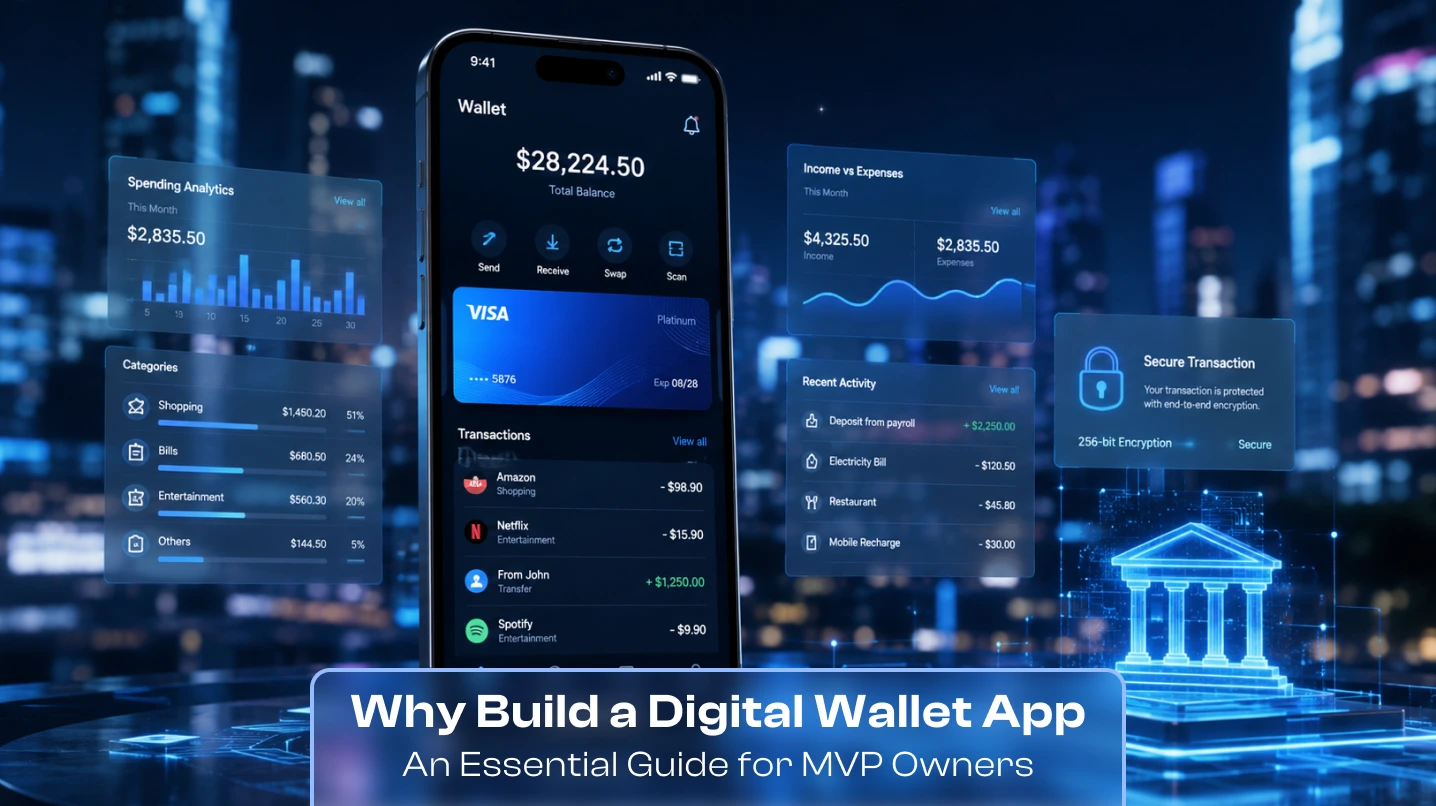
Introduction
Here is a number that should make you pause: as of 2024, over 3.4 billion people use a digital wallet globally. That is nearly half the planet’s adults. And yet most wallet apps built by startups fail within 18 months.
Not because the idea was bad. Because the founders did not understand what they were actually building.
A digital wallet app is not a payments interface layered on top of an API. It is a trust infrastructure. And trust infrastructure has requirements that don’t show up on a feature list.
If you are a founder, CTO, or product leader thinking about building a digital wallet MVP, this guide is written specifically for you. Not to convince you to build, but to make sure you are building the right thing in the right sequence.
What a Digital Wallet App Actually Is (And Is Not)
Most people conflate “digital wallet” with a payments app. They are not the same thing.
A payments app moves money. A digital wallet stores it. That distinction sounds minor until you realize it changes your entire regulatory posture.
If your wallet holds user funds, even briefly, you are operating in a completely different legal category than if you are simply routing transactions. Stored value is regulated at the state or country level. In the US, that means money transmitter licenses. In the EU, it means an e-money institution license or partnership with one.
Before your product team writes a single user story, your legal team (or legal partner) needs to define exactly what type of wallet you are building:
Closed-loop wallet: Funds can only be used within your own ecosystem. Think prepaid loyalty cards. Easier to license, limited growth ceiling.
Open-loop wallet: Funds interact with external financial rails (ACH, card networks, etc.). Harder to license, far more commercially viable.
Pass-through wallet: You never hold funds. You connect accounts and route transactions. Much simpler regulatory path.
Most MVP owners think they want option two when they actually need to start with option three. That shift alone can save you six months and significant compliance costs.
The Real Reasons Founders Build Digital Wallet Apps
Let’s be honest about motivation. There are good reasons to build a wallet app and ones that will get you into trouble.
Good reasons
- You have a captive user base that currently uses fragmented payment methods (marketplaces, gig economy platforms, gaming ecosystems)
- You want to reduce transaction costs by owning the payment layer
- You are building a financial inclusion product for underbanked markets where traditional banking access is low
- You are creating a vertical-specific wallet for a niche that existing providers serve poorly (healthcare payments, creator economy payouts, B2B procurement)
Reasons that will cost you
- You want to “be the next PayPal” without a clear user acquisition strategy
- You assume the tech is the hard part and compliance is just paperwork
- You are building a wallet because your investors think fintech multiples are attractive
The wallet apps that survive are the ones solving a real, specific friction for a real, specific group of people. The generic consumer wallet market is already dominated by Apple Pay, Google Pay, PayPal, and dozens of regional players. You cannot win there on features alone.
Core Features of a Digital Wallet MVP: What to Build First
The mistake most product teams make is treating an MVP like a reduced version of their full vision. A digital wallet MVP should instead be a complete vertical slice of one workflow, done to production quality.
01
Identity Layer
KYC/KYB onboarding, document verification, fraud scoring
02
Account Core
Wallet balance, transaction ledger, real-time reconciliation
03
Money Movement
Deposit, withdrawal, and transfer flows with provider integrations
04
Security Layer
Encryption at rest and in transit, 2FA, device fingerprinting
Notice what is not on that list: advanced analytics dashboards, social payment features, loyalty points, crypto integration. Those come later. Your MVP needs to do one thing: let a user store and move money safely. Everything else is noise until you have validated that core loop.
The ledger is your most important architectural decision
Most non-fintech developers underestimate the ledger. A wallet is essentially a database of debits and credits. If your ledger logic has bugs, you end up with reconciliation errors, which means your users’ balances are wrong, which means you have a compliance and trust crisis.
Double-entry bookkeeping is not optional. Every transaction should create two ledger entries. This is accounting 101, but it gets skipped in early MVP builds constantly. Fix it later and you will spend three months untangling a mess.
You should also decide early whether you are building your own ledger or using a provider like Modern Treasury, which handles the double-entry accounting, reconciliation, and bank connectivity so your team can focus on the product layer instead of financial infrastructure.
Technology Architecture: Where MVPs Go Wrong
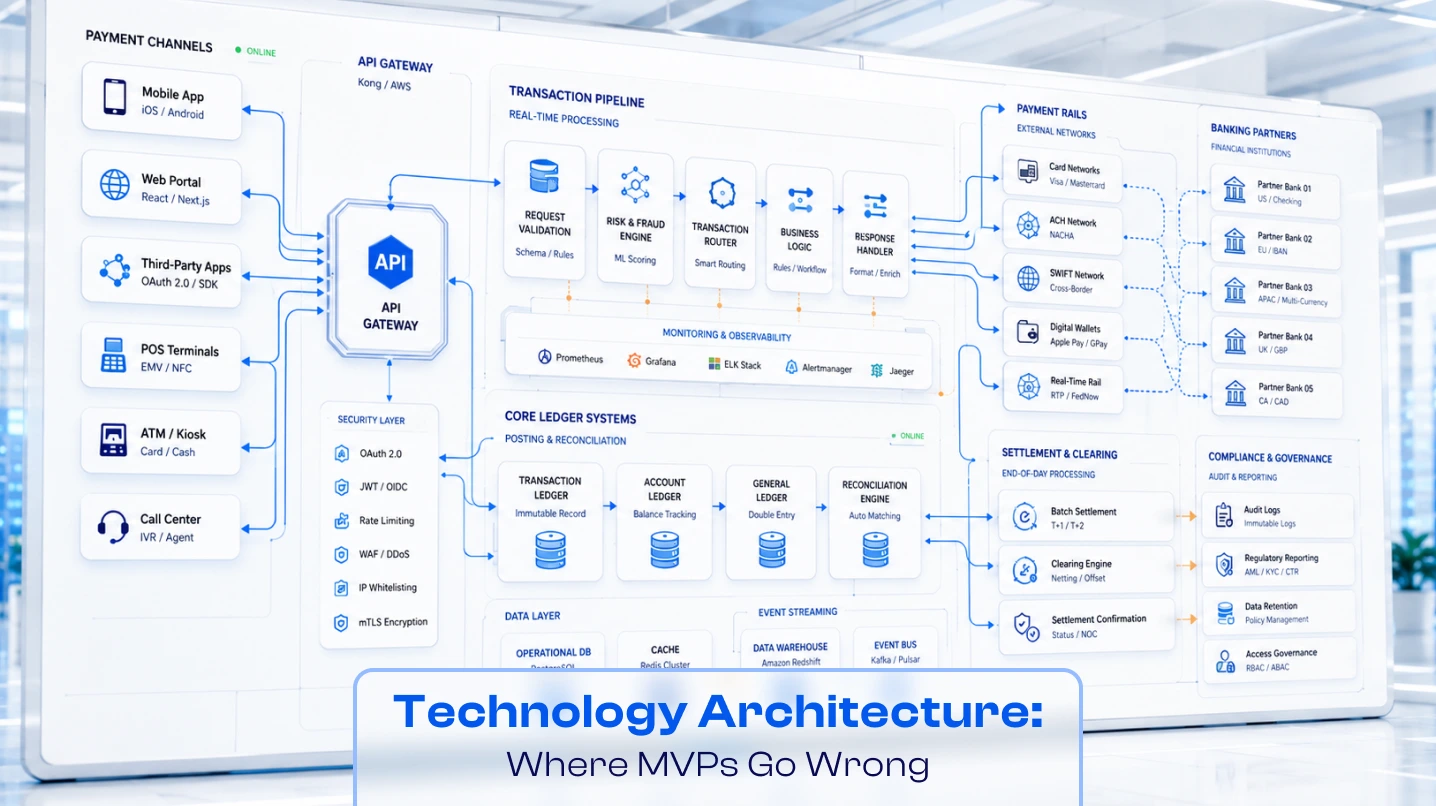
The three most common architectural mistakes in digital wallet apps:
1. Monolith for a product that needs to scale in unpredictable ways
A monolith is fine for most MVPs. For a wallet app, it is a specific problem. Financial systems need to isolate failure. If your notification service goes down, that should never affect your transaction processing. If your analytics pipeline has a bug, it should never touch your ledger.
You do not need microservices from day one. But you do need logical separation from day one. Build with bounded contexts in mind, even if you deploy as a single service initially. The refactor cost if you don’t is enormous.
2. Synchronous transaction processing
Transactions need to be idempotent and asynchronous. If a user taps “Send” and the network drops, does your system create one transaction or two when the retry comes in? If your answer is “it depends,” you have a problem.
Every transaction should have a unique idempotency key. Every state change should be event-driven. Your system should be able to reconstruct the state of any wallet at any point in time from the event log. This is not over-engineering. This is the minimum viable standard for a financial product.
3. Treating compliance as a feature, not a foundation
AML (Anti-Money Laundering) checks, sanctions screening, and transaction monitoring are not features you add after launch. They are table stakes for operating a wallet. If you go live without these and regulators notice, you are not just fined. You can lose your operating license.
Third-party providers like Sardine, Unit21, or Sift can handle much of this for early-stage products. Using them correctly from the start is far cheaper than building from scratch or retrofitting later.
Compliance and Licensing: The Real Timeline
Nobody tells you this upfront, so here it is: if you are building a wallet that holds user funds in the US, getting a money transmitter license in all 50 states takes 12 to 24 months and can cost $1M or more.
Most startups solve this through a partnership model. You find a licensed money service business or bank partner and operate under their license. This is how most fintech startups launch. Stripe Treasury, Synapse (now defunct), Column, and Evolve Bank are examples of the infrastructure that powers these arrangements.
But understand the tradeoff: you are now dependent on a partner whose decisions you cannot control. If they change their API, change their terms, or get acquired, your product is at risk. Plan for that dependency from the start.
Founder insight
The companies that hit a wall with wallet apps almost always have the same story: they built the product, then tried to figure out compliance. The companies that succeed build compliance into their architecture from the first sprint. It adds time upfront and saves months of crisis management later.
Build vs. Buy: A Framework for MVP Owners
One of the most consequential decisions you will make is what to build and what to integrate. Here is a simple way to think about it:
Build only what creates your competitive advantage. Everything else, buy or partner.
In practice, that means:
- Build: Your unique UX, your risk scoring logic (if that’s your moat), your specific product workflow
- Buy/integrate: KYC verification (Persona, Jumio, Onfido), card issuance (Marqeta, Lithic), banking connectivity (Plaid, MX), ledger and payment infrastructure (Modern Treasury, Unit, Treasury Prime)
The founders who try to build their own KYC pipeline or card issuance infrastructure in their MVP are making a category error. You are a product company, not an infrastructure company. Act like one.
How to Structure Your Development Partnership
If you are working with an external development team to build your wallet app, the structure of that engagement matters as much as the team’s technical skill.
A fintech product like a wallet app needs a team that has done this before. Not because fintech is magical, but because the specific combination of security requirements, ledger logic, and third-party integrations creates failure modes that only experience surfaces early.
Questions worth asking any agency or development partner:
- Have you built products that handle financial transactions? What was the ledger architecture?
- How do you handle compliance requirements in your development process?
- What is your approach to security audits and penetration testing?
- Can you show examples of how you have handled API integrations with financial infrastructure providers?
If a development team cannot answer those questions specifically, they are generalists. That is fine for many projects. For a wallet app, you want specialists. You can explore what a structured fintech development engagement looks like at Pedals Up’s services page.
What Makes a Wallet App Actually Succeed Post-MVP
The product work does not end at launch. Most wallet apps that gain traction do three things well after their MVP:
They obsess over activation, not acquisition
Getting users to download a wallet app is easy. Getting them to fund it and make a first transaction is the actual challenge. Your onboarding flow and your first-use experience determine whether you have users or just installs. Map your activation funnel before you build, not after.
They find a use case with transaction frequency
A wallet people use once a month is a feature. A wallet people use daily is a business. The products that win build around high-frequency use cases: daily commutes, recurring bills, peer transfers, merchant loyalty. The use case determines the engagement model.
They treat security as a marketing asset
Trust is the product in fintech. Transparent communication about security practices, clear dispute resolution flows, and visible compliance credentials are not just legal requirements. They are conversion drivers. Users who trust your security talk about it.
The Takeaway
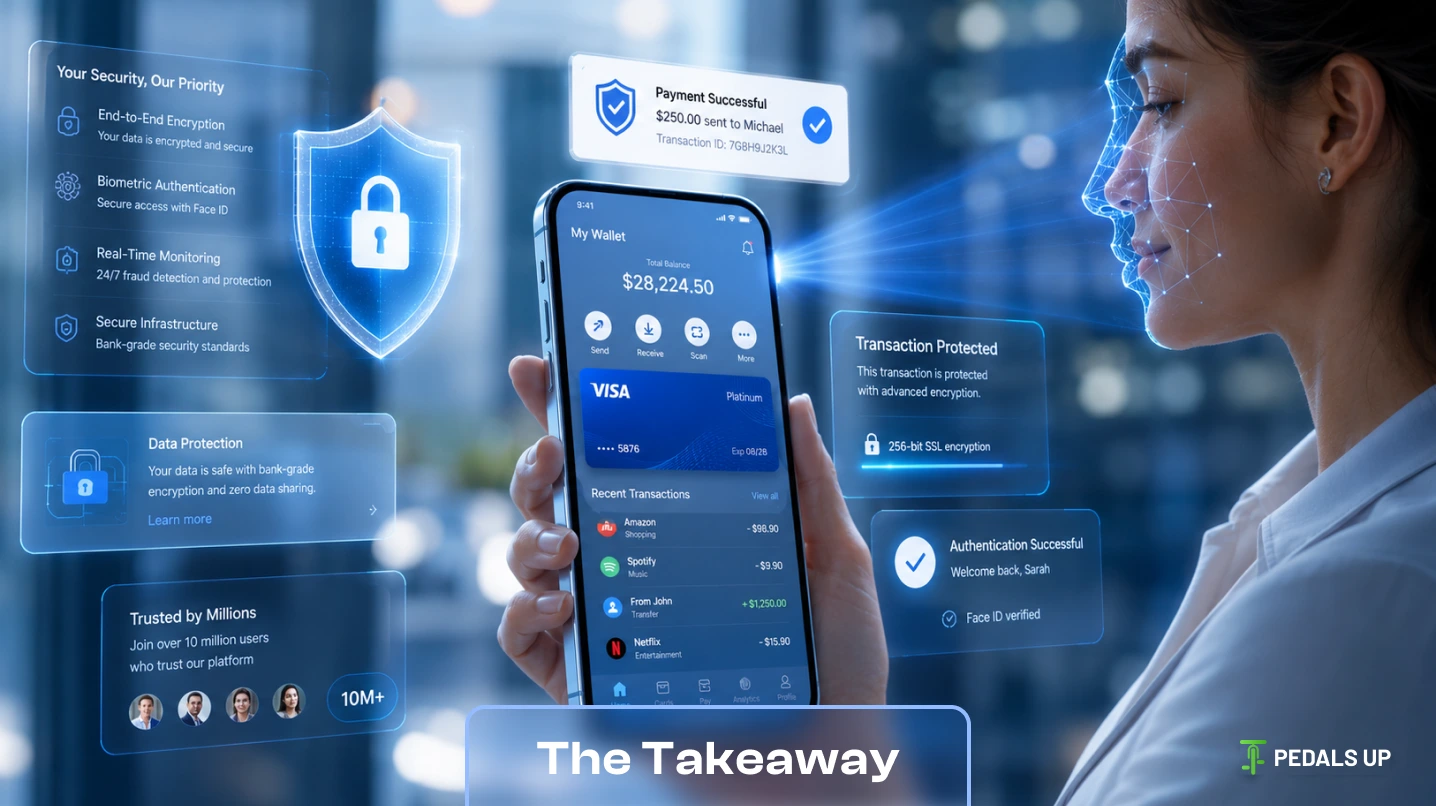
Building a digital wallet app is not a technology problem. It is an architecture problem, a compliance problem, and a trust problem, all wrapped in a product that needs to work flawlessly every single time.
The founders who succeed are the ones who scope precisely, partner wisely, and treat the regulatory and financial infrastructure layer with the same seriousness they give to their UX. The ones who struggle treat compliance as an afterthought and the ledger as a detail.
If you are serious about building a wallet app, define your wallet type first. Understand your licensing path before you start development. Choose your infrastructure partners before your tech stack. And find a development team that has seen these problems before.
That sequence is not exciting. But it is the sequence that works.