
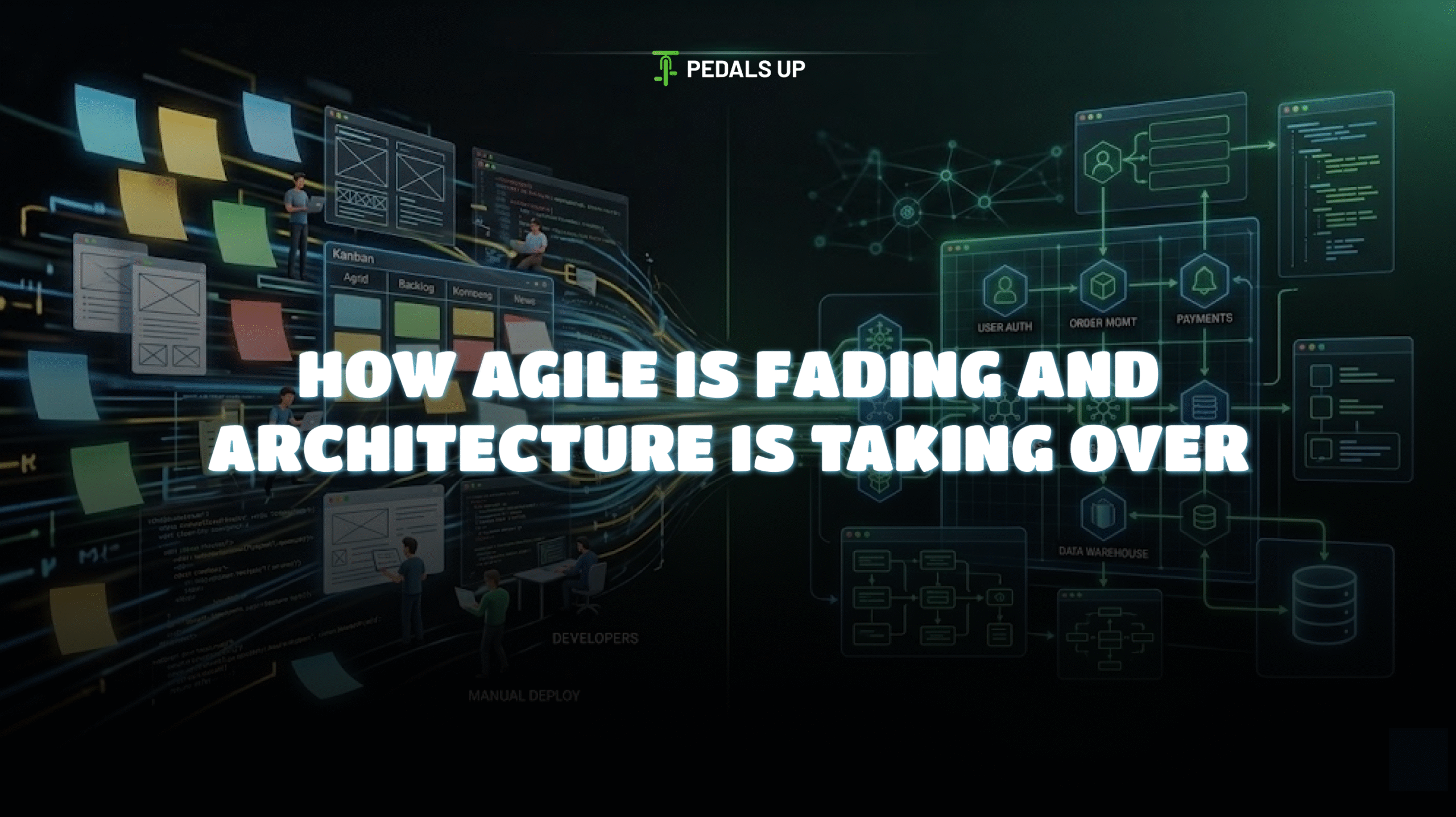
Introduction
For years, Agile was the answer to everything.
Need faster delivery? Go Agile.
Need better collaboration? Go Agile.
Need to build products users love? Definitely Agile.
But here’s the uncomfortable truth in 2026: Agile isn’t failing because it’s wrong. It’s failing because it’s incomplete.
Teams are shipping faster than ever, yet products break at scale. Features roll out weekly, but systems can’t handle growth. Startups move quickly, only to spend months rewriting everything once they hit traction.
The problem isn’t speed.
The problem is what you’re building on.
And that’s where software architecture comes in.
The Rise and Plateau of Agile
Agile changed the game. It replaced rigid, long-cycle development with iterative, flexible execution.
It introduced:
- Sprint-based delivery
- Continuous feedback loops
- Cross-functional teams
- Faster time to market
And for a while, it worked beautifully.
But Agile was built for a different era, one where:
- Systems were simpler
- Scale was predictable
- Integrations were limited
- AI wasn’t part of the stack
Today, that world doesn’t exist anymore.
Where Agile Starts Breaking Down
1. Speed Without Structure
Agile optimizes for speed. But speed without architectural direction leads to chaos.
Teams keep shipping:
- New features
- New integrations
- New workflows
But without a strong foundation, every addition increases technical debt.
Eventually, the system becomes fragile.
2. Local Optimization, Global Problems
Agile teams focus on sprint goals, not system-wide impact.
This leads to:
- Micro-decisions that don’t scale
- Inconsistent data flows
- Fragmented user experiences
Each team moves fast, but the product as a whole slows down.
3. The AI Complexity Explosion
Modern products are no longer just CRUD apps.
They involve:
- AI agents
- Real-time processing
- Multi-platform experiences
- Complex APIs and services
Agile doesn’t inherently address how these systems should be structured. It only focuses on how fast they can be built.
That gap is where most products fail.
Why Architecture Is Taking Over
Architecture is no longer a “nice-to-have” upfront exercise. It’s becoming the backbone of successful products.
Because in 2026, the real challenge isn’t building features.
It’s building systems that survive.
1. Architecture Enables Scale from Day One
A well-designed architecture ensures:
- Systems don’t collapse under user growth
- New features don’t break existing ones
- Performance remains stable
Instead of rewriting your backend after success, you grow into it.
2. It Reduces Long-Term Costs
Poor architecture is expensive.
Not immediately, but over time:
- Debugging becomes harder
- Development slows down
- Infrastructure costs increase
- Rewrites become inevitable
Strong architecture avoids all of this.
3. It Aligns Teams, Not Just Tasks
Architecture provides a shared blueprint.
Instead of teams working in silos, they operate within a unified system design.
This leads to:
- Cleaner integrations
- Better collaboration
- Faster, more predictable releases
Real-World Example: When Agile Wasn’t Enough
Take the early scaling challenges faced by Uber.
In its early days, Uber moved fast with rapid feature releases. But as it expanded globally, its system faced serious issues:
- Monolithic architecture couldn’t handle scale
- Deployment cycles became risky
- Small changes caused large failures
The solution wasn’t “more Agile.”
It was a complete architectural shift to a microservices-based system.
This transformation allowed Uber to:
- Scale globally
- Improve reliability
- Enable independent team deployments
The takeaway is clear: speed got them started, architecture kept them alive.
Agile Isn’t Dead, It’s Just Not Enough
This isn’t about replacing Agile.
It’s about reframing it.
Agile should operate within architectural boundaries, not replace them.
Think of it like this:
- Agile decides how you build
- Architecture decides what and where you build
Without architecture, Agile becomes directionless.
The Shift: From Sprint Thinking to System Thinking

Modern development is moving toward a different mindset.
Old Approach (Agile-First)
- What can we ship this sprint?
- How fast can we deliver?
- What’s the next feature?
New Approach (Architecture-First)
- How will this scale in 12 months?
- How does this impact the entire system?
- Is this sustainable long-term?
This shift changes everything.
What Modern Architecture Looks Like in 2026
Today’s architecture isn’t just about backend diagrams.
It’s about designing systems that are:
- Modular and composable
- API-first
- Cloud-native
- AI-ready
- Event-driven
It also includes decisions around:
- Data flow and ownership
- Service boundaries
- Performance optimization
- Security and compliance
In short, it’s strategic, not just technical.
Where Most Teams Get It Wrong
1. Treating Architecture as Documentation
Architecture isn’t a document you create once.
It’s a living system that evolves with your product.
2. Ignoring It Until It’s Too Late
Most teams only think about architecture after things break.
By then:
- Fixes are expensive
- Systems are fragile
- Growth slows down
3. Relying on AI or “Vibe Coding”
AI can generate code. It cannot design scalable systems.
Without expert oversight:
- Systems lack cohesion
- Decisions are inconsistent
- Long-term stability is compromised
AI is a tool, not an architect.
Why Businesses Are Moving Toward Architecture-Led Teams
In 2026, companies are prioritizing:
- System architects over just developers
- Long-term scalability over short-term speed
- Stability over constant feature churn
Because the market has changed.
Users expect:
- Instant performance
- Zero downtime
- Seamless experiences
You can’t deliver that without strong architecture.
How Pedals Up Approaches This Shift
At Pedals Up, development doesn’t start with sprints.
It starts with understanding:
- The product vision
- The scale expectations
- The system complexity
From there, we design architectures that:
- Support growth from day one
- Minimize technical debt
- Enable faster, cleaner development
Once the foundation is strong, Agile becomes powerful again.
Not chaotic. Not reactive. But aligned.
Explore how we approach scalable product development here: Our Services
Conclusion
Agile didn’t fail. It just reached its limit.
In a world of AI-driven systems, global scale, and real-time experiences, speed alone isn’t enough.
Architecture is what makes speed sustainable.
The teams winning in 2026 aren’t the ones shipping the fastest.
They’re the ones building systems that don’t break when they do.