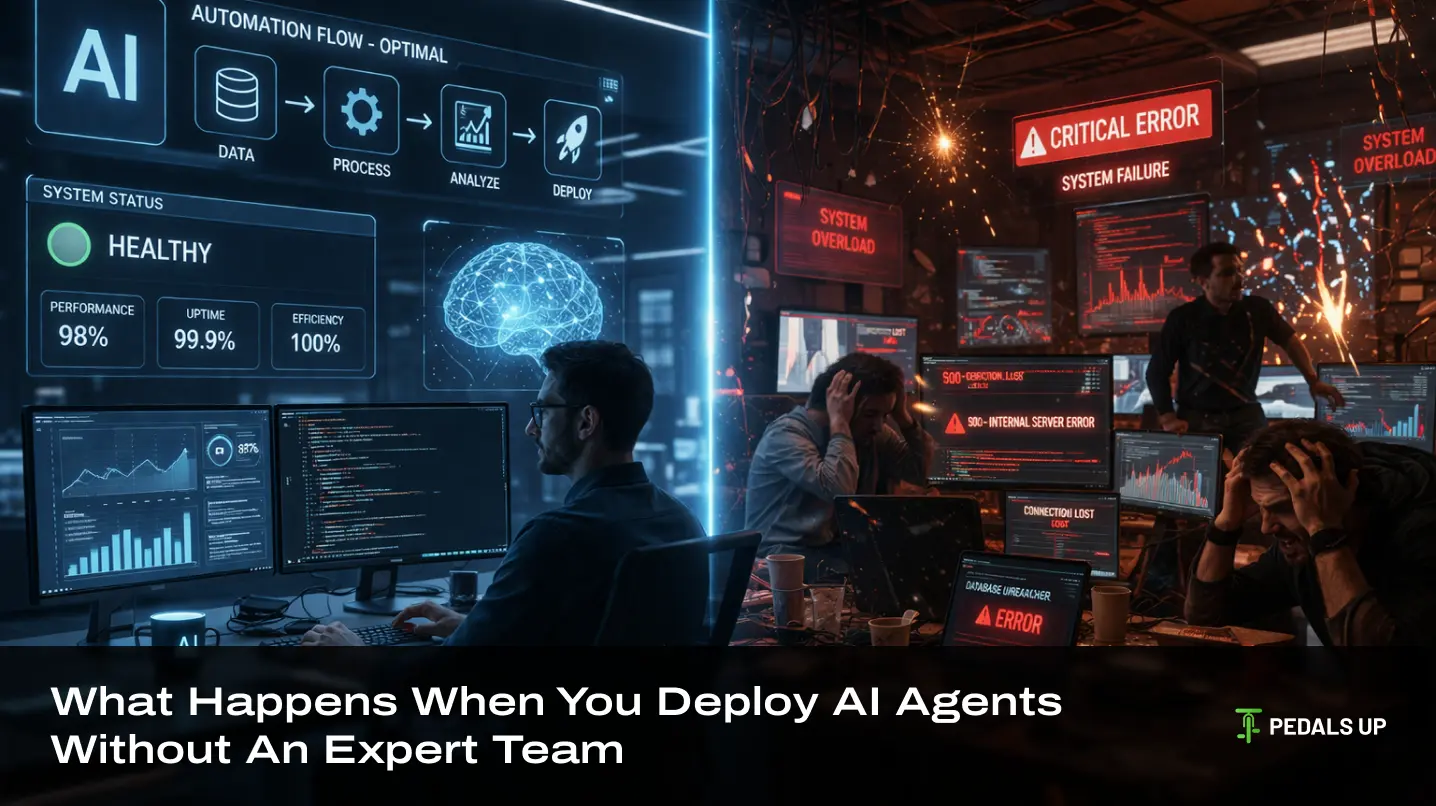
What Happens When You Deploy AI Agents Without an Expert Team
AI agents are everywhere right now.
You can spin up workflows, connect APIs, generate logic, and automate tasks faster than ever using tools powered by companies like OpenAI and Anthropic.
On the surface, it feels like a breakthrough moment.
- No heavy engineering.
- No complex systems.
- Just prompts, integrations, and automation.
But here’s the reality most teams only realize after deployment:
- AI agents are easy to demo.
- They are hard to scale.
- And even harder to trust in production.
The Rise of “Vibe Coding”
There’s a new pattern emerging in 2026.
Teams are building AI products by stitching together tools, prompts, and APIs without deep technical understanding. It feels fast, flexible, and powerful.
This approach is often called “vibe coding.”
It works well for:
- Prototypes
- Internal tools
- Quick experiments
But it breaks down when you try to build a real product.
Because production systems are not just about getting outputs.
They are about reliability, consistency, and control.
The First Failure: Inconsistent Output
AI agents do not behave like traditional software.
The same input can produce:
- Slightly different outputs
- Completely wrong answers
- Unexpected edge cases
Without proper guardrails, this creates a serious problem.
For example:
- A customer support agent gives conflicting responses
- A financial assistant generates incorrect insights
- A workflow automation breaks silently
Unlike traditional bugs, these failures are not always predictable or repeatable.
An expert team is needed to:
- Design prompt strategies
- Implement validation layers
- Monitor output quality
Without that, your product becomes unreliable.
The Second Failure: No System Architecture
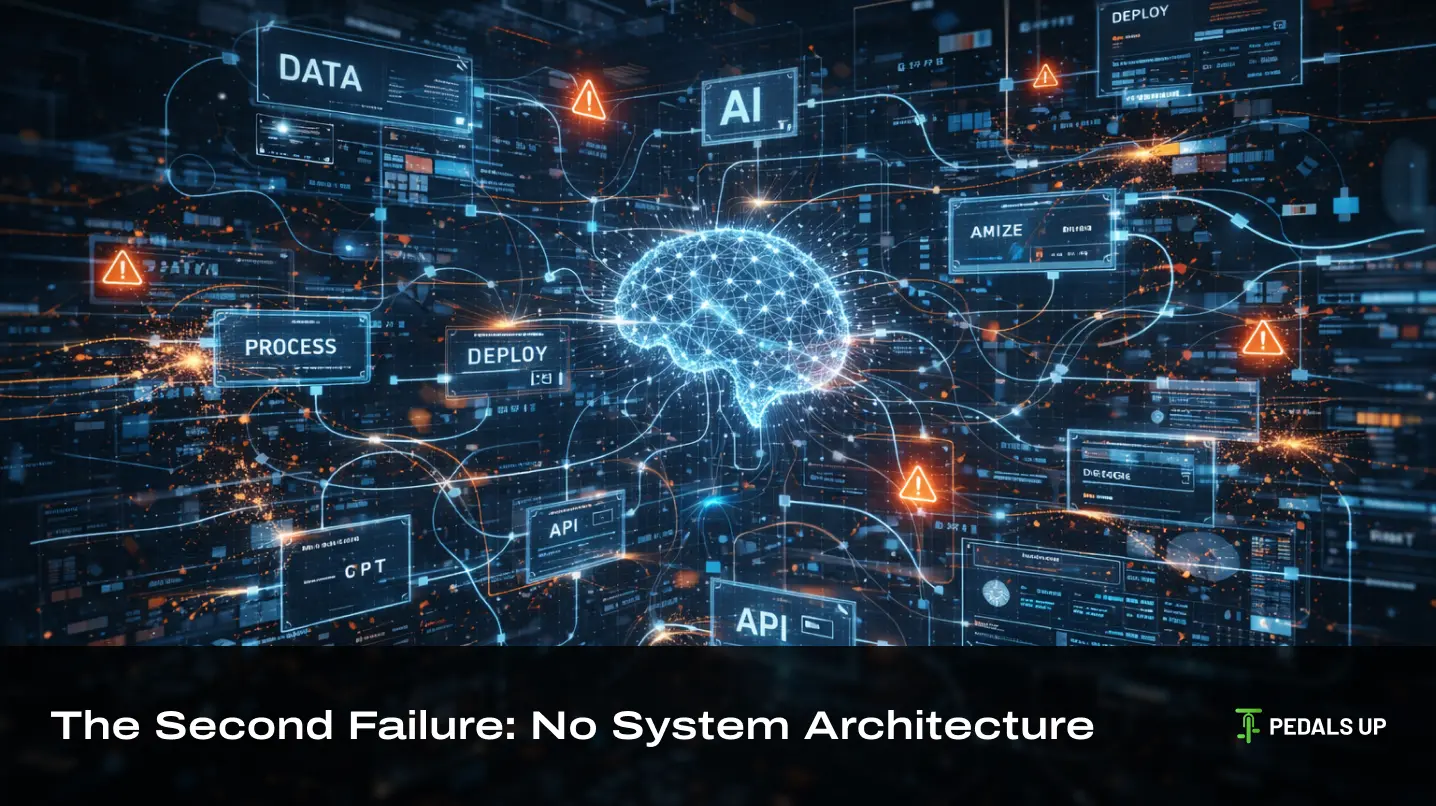
Most AI-first builds ignore architecture.
They rely heavily on:
- API calls
- Prompt chaining
- Third-party tools
But as usage grows, this creates chaos.
Problems start appearing:
- Slow response times
- High API costs
- Poor error handling
- Lack of scalability
Building a real AI product requires:
- Backend orchestration
- Caching strategies
- Queue management
- Failover systems
These are engineering problems, not prompt problems.
The Third Failure: Security and Data Risks
AI agents often interact with sensitive data.
Without a strong tech team, teams overlook:
- Data exposure risks
- Improper API access
- Weak authentication
- Compliance gaps
This is especially dangerous in industries like:
- Fintech
- Healthcare
- SaaS platforms
Security is not something you fix later. It has to be designed from the beginning.
The Fourth Failure: No Control Over Behavior
AI agents evolve based on prompts, context, and integrations.
Without structured control systems, you lose visibility into:
- Why the agent made a decision
- How outputs are generated
- What happens in edge cases
This becomes a major issue when:
- Users question results
- Errors impact business outcomes
- Systems need debugging
Expert teams build:
- Logging systems
- Observability layers
- Version control for prompts
- Testing pipelines
This transforms AI from unpredictable behavior into manageable systems.
The Fifth Failure: Cost Explosion
AI looks cheap at the start.
Then usage scales.
- API calls increase.
- Processing grows.
- Latency increases.
Suddenly, costs spiral.
Without optimization strategies like:
- Model selection
- Request batching
- Token control
- Hybrid architectures
AI products become financially unsustainable.
This is where engineering discipline directly impacts business viability.
Real World Pattern: Why Most AI Products Stall
Across the industry, a common pattern is emerging.
Teams launch AI-powered features quickly.
Initial traction looks promising.
Then:
- Performance issues surface
- Costs increase
- Edge cases break flows
- Users lose trust
This is why many AI-first products fail to move beyond early traction.
The gap is not in AI capability.
It is in execution.
What Expert Teams Actually Do Differently
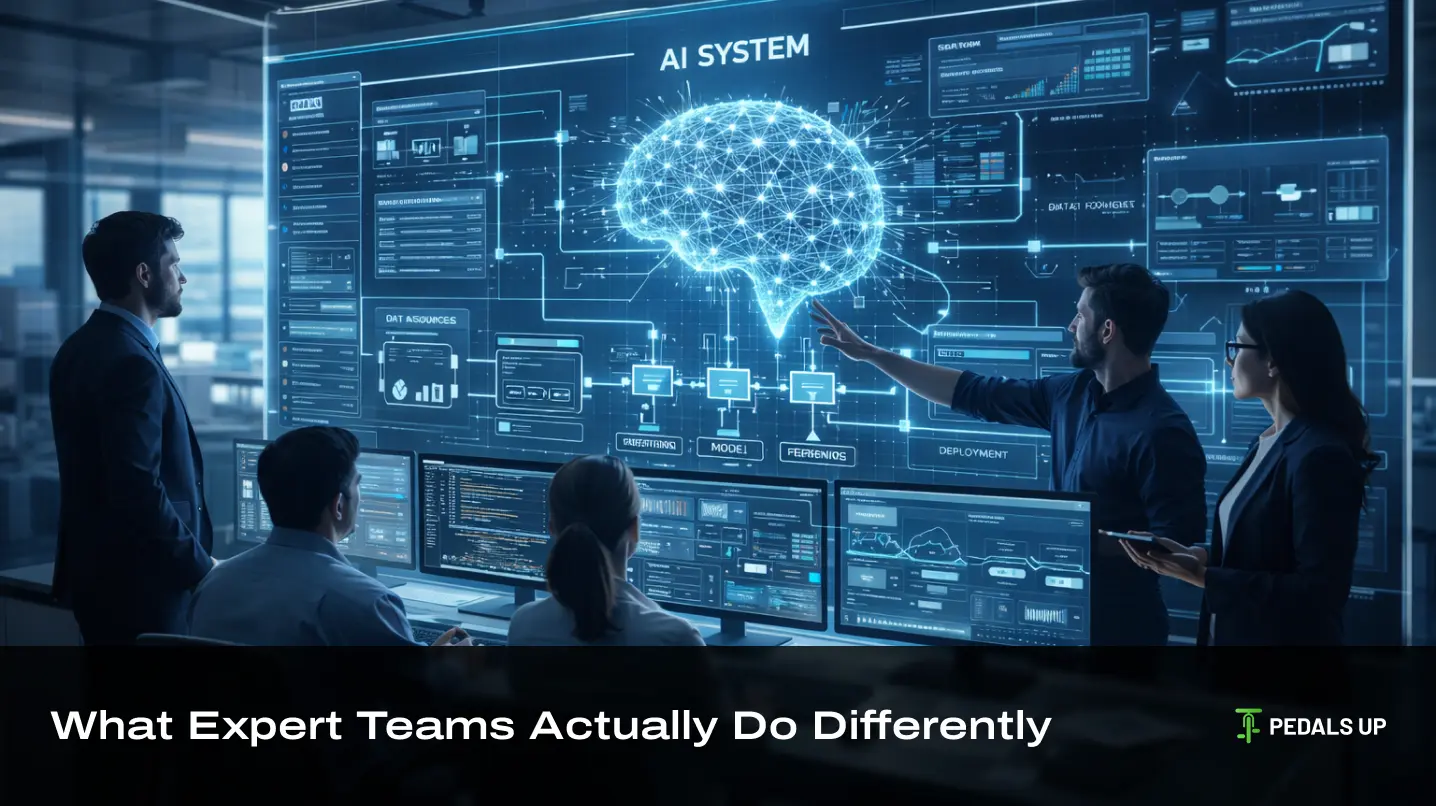
The difference between a working demo and a scalable product is the team behind it.
Experienced tech teams approach AI systems with structure.
They focus on:
1 System Design
AI is treated as one component within a larger architecture, not the entire solution.
2 Reliability Engineering
They build systems that handle:
- Failures
- Edge cases
- Unexpected outputs
3 Performance Optimization
They optimize:
- Response time
- Cost efficiency
- Throughput
4 Security and Compliance
They ensure data is handled safely and systems meet regulatory standards.
5 Continuous Improvement
They monitor usage, collect feedback, and refine models and workflows over time.
AI Is Not a Product. It Is a Layer
One of the biggest misconceptions in 2026 is that AI itself is the product.
It is not.
AI is a layer within a product.
The real product includes:
- User experience
- System architecture
- Data pipelines
- Business logic
- Performance reliability
Without these layers, AI alone cannot deliver value.
Why “Vibe Coding” Fails in Production
“Vibe coding” works because it removes friction.
But it also removes discipline.
It skips:
- Architecture planning
- Testing frameworks
- Performance considerations
- Security design
That is why it fails under real-world pressure.
What works in a demo environment often collapses when:
- Thousands of users interact with the system
- Edge cases increase
- Data complexity grows
Products survive on systems, not shortcuts.
The 2026 Reality: Execution Is the Differentiator
AI tools are becoming accessible to everyone.
That means the competitive advantage is no longer access to AI.
It is execution.
The companies that win will be those that:
- Build structured AI systems
- Invest in strong engineering teams
- Focus on reliability and scalability
The rest will struggle with unstable products and declining user trust.
Conclusion
Deploying AI agents without an expert team is one of the fastest ways to create fragile products.
What starts as a powerful idea often turns into:
- Inconsistent outputs
- Broken workflows
- Security risks
- Rising costs
AI is not magic. It is infrastructure.
And like any infrastructure, it requires:
- Strong architecture
- Skilled engineers
- Continuous monitoring
In 2026, the difference between AI hype and real product success comes down to one thing:
The team building it.
At Pedals Up, we help businesses move beyond AI experiments and build structured, scalable AI-powered products that perform in real-world conditions.
If you are building with AI, don’t rely on shortcuts.
Work with a team that understands how to turn AI capabilities into reliable, scalable systems.
Connect with Pedals Up to build AI products that actually survive and grow.