Table of contents
RWA Product Development: The Essential Work Beyond Tokenization
Tokenizing a real-world asset is one technical step. RWA product development is the much larger job of building everything around that token. Pedals Up is an AI-native product engineering company that builds web, mobile, SaaS, and Web3 products, including real-world asset and tokenization platforms, for founders and CTOs across fintech, real estate, and Web3.
A smart contract can create tokens and assign them to wallets. It cannot decide what those tokens legally represent, who can buy them, what rights the holder receives, how ownership is recorded, or what happens when the underlying asset changes.
That is where RWA product development turns into a product engineering problem rather than a smart contract problem.
For a tokenized real estate platform, for example, the technology needs to connect property records, legal ownership, investor onboarding, eligibility checks, wallets, token balances, transfers, distributions, reporting, and administrative workflows.
The blockchain is one part of that system. It is not the whole system.
What is RWA tokenization?
RWA tokenization is the process of representing ownership of, or an economic interest in, a physical or financial asset through a digital token. The underlying asset could be real estate, private credit, a fund interest, an invoice, a commodity, or another tangible or financial asset. The token represents ownership or economic rights and, depending on the structure, can carry programmable rules governing who can hold or transfer it. Tokenization itself does not answer the core product questions: who owns the underlying asset, what rights the holder gets, how income gets distributed, and what happens when ownership changes. Those questions sit around the token, not inside it.
Is tokenizing an asset the same as building an RWA product?
No. Tokenization is a technical step. An RWA product has to make the entire asset lifecycle work: the legal structure and underlying asset, investor onboarding and compliance (KYC and AML), issuance and ownership records and transfer logic, and servicing, income distributions, and reporting. A platform that stops at token issuance solves only one part of the problem. The token can work perfectly on-chain while the product around it stays incomplete off-chain.
What does an RWA product need to handle?
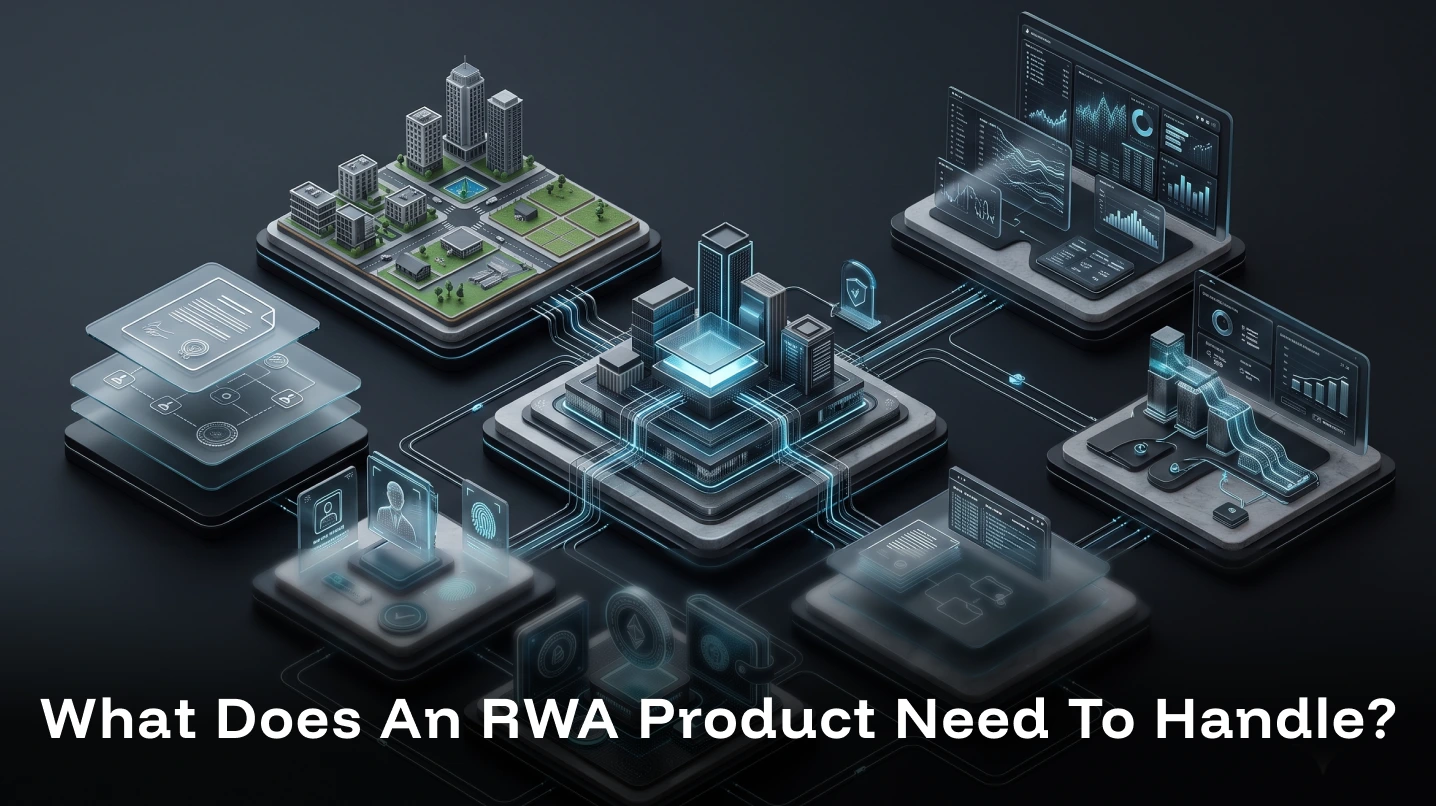
A working RWA product connects systems that are traditionally handled in silos. At a minimum, the platform has to manage:
- The underlying asset: valuations, title records, and performance tracking
- Legal and ownership structure: token-holder rights and entity relationships
- Investor onboarding and compliance: KYC, AML, accredited-investor checks, sanctions screening
- Token issuance and permissions: minting rules, wallet allowlists, regulatory restrictions
- Ownership records and transfers: cap tables, primary distribution, secondary settlement
- Payments and servicing: distributions, corporate actions, redemptions
- Data pipelines: keeping on-chain token state synchronized with off-chain records
Having each component isn’t the hard part. Getting the components to agree with one another is where most of the engineering work sits.
1. Start with the asset, not the token
Before deciding how to tokenize an asset, define what is actually being represented. In real estate, that could be a single property, a portfolio, or an interest held through a legal entity. For another RWA product, the underlying asset might be private credit, a fund, an invoice, a commodity, or another financial interest.
The product needs a clear asset layer, which may include asset documentation, ownership or beneficial-interest information, valuation data, asset status, legal entity information, income or performance history, and a link between the underlying asset and its digital representation.
If the asset information is incomplete or hard to verify, putting a token on a blockchain does not solve that problem. The token still needs something reliable behind it.
2. Legal structure sits beside the technology
One of the biggest mistakes in RWA product planning is assuming a token automatically represents legal ownership of an asset. It does not. What a token represents depends on how the underlying asset and legal structure have been set up.
The SEC’s January 2026 statement on tokenized securities notes that tokenized securities can use different structures, and that the legal rights and obligations involved depend on the relevant structure and applicable law. That has a direct impact on product development.
Before the engineering team finalizes the architecture, the business and its legal advisers need to settle questions like: what exactly does the token represent, who legally owns the underlying asset, what rights does the token holder receive, how are distributions handled, who is eligible to hold the token, what happens when a holder redeems, and what restrictions apply to transfers.
These are not questions a smart contract should answer on its own. The technology should implement an approved structure. It should not invent the structure.
This article discusses product and engineering considerations, not legal advice. The legal treatment of an RWA product depends on the asset, structure, offering, and jurisdictions involved.
3. Investor onboarding is part of the product
An RWA product still needs to know who is investing. Depending on the structure, that can involve identity verification, accredited-investor checks, jurisdiction restrictions, sanctions screening, and wallet approval, which means onboarding can’t be treated as a separate form sitting in front of the platform.
The onboarding system needs to connect with the rest of the product, so the platform always knows whether a given wallet is cleared to buy, hold, transfer, or redeem at any given moment, not just which wallet sent a transaction.
The result is a product that connects identity, eligibility, wallets, assets, and transactions. That’s closer to financial software than a Web3 application with a login screen.
4. The token needs rules, not only a mint function
Creating a token is only the beginning. The product also has to define what that token can do: holding and location limits, transfer approvals that check buyer and seller eligibility before a transaction finalizes, and redemption logic for taking tokens out of circulation.
Some of these rules get implemented in the application. Others get enforced through smart contracts. The important thing is that the two sides agree. If the application says a transfer is allowed but the smart contract rejects it, the investor hits a broken transaction. If the blockchain records a transfer but the platform’s internal records don’t update, the business has an operational problem.
To enforce these rules directly on-chain, teams generally reach for one of two permissioned token approaches. ERC-3643 pairs the token contract with an on-chain identity registry and compliance module, so eligibility and transfer rules are checked at the protocol level. ERC-1400, maintained by the Security Token Standard community, takes a different approach built around partially fungible token tranches, document management, and transfer-control hooks. Some teams instead build a lighter compliance layer on top of a plain ERC-20 token with custom transfer-restriction logic, though that’s a bespoke pattern rather than a named standard. Which one fits depends on the legal structure and operational requirements, not on which is newest.
5. Ownership records need to make sense end to end
An RWA platform needs an explicit chain: investor, wallet, token, legal interest, underlying asset.
If an investor holds 500 tokens representing an interest in a property, the platform should be able to determine who owns those tokens, which wallet holds them, what interest they represent, what rights come with that interest, what distributions are tied to it, and what happens to the investor’s position if the property is sold.
The blockchain records state changes. It doesn’t store the full business and legal picture, which is why ownership data has to be designed across the entire system rather than treated as a smart contract problem.
6. Issuance is only the beginning
The primary sale gets a lot of attention because it’s where the token first reaches investors. The operational layer that follows is where most of the long-term product work sits: investor balances and statements, distributions and corporate actions, redemptions and transfers, notifications, portfolio reporting, transaction history, and tax records.
This layer is easy to underestimate because it’s less visible than the token itself. It’s also the part investors and operators interact with daily.
7. Secondary transfers need their own logic
Putting an asset on-chain doesn’t automatically create a liquid secondary market. A permitted transfer still needs a sequence of checks: is the seller’s wallet clear of locks or holding-period restrictions, is the buyer eligible and onboarded, is the receiving wallet approved, does the transaction need additional review, and how does settlement actually happen?
Some platforms enforce transfer restrictions directly through the token infrastructure. Others rely on separate regulated market infrastructure, using the blockchain mainly for recording or settlement. Tokenization changes where some of the infrastructure sits. It doesn’t remove the need for that infrastructure.
8. Payments and distributions are where investors see the product
An investor experiences an RWA platform through its cash flows and reporting, not through the smart contract code.
For a tokenized real estate product generating rental income, the distribution loop typically runs: asset income comes in through traditional banking rails or a stablecoin reserve, the platform calculates each investor’s allocation from a balance snapshot, payment goes out, and the transaction record and investor statement update. Redemptions run the same sequence in reverse. Burning a token only counts as a redemption once the financial settlement and ownership records are fully aligned with it.
This is why many RWA products combine blockchain infrastructure with traditional financial systems rather than trying to replace those systems entirely.
9. Reporting matters more as the platform grows
An RWA platform produces data that has to be useful to different people without breaking consistency between them.
Investors typically need portfolio performance, transaction history, ownership statements, distribution history, valuation updates, and tax information. Operators typically need investor registries, wallet audit trails, compliance status, exception flags, and administrative controls. Those are different jobs, and a strong architecture gives each audience its own view while keeping a single source of truth underneath.
How do on-chain and off-chain systems work together?
A practical RWA product rarely lives entirely on a blockchain. A typical architecture stacks several layers together:
|
Layer |
Primary functions |
|
Asset and legal layer |
Title records, legal entity structures, valuation reports, documents |
|
Application layer |
Investor and admin portals, portfolio tracking, support |
|
Compliance layer |
Identity checks, jurisdiction logic, accreditation, allowlists |
|
Token layer |
Smart contracts, minting and burning, transfer rules, permission standards |
|
Financial infrastructure |
Banking rails, payment gateways, stablecoin rails, custody |
|
Data and reporting layer |
Audit logs, cap tables, tax documents, performance analytics |
The exact architecture changes from product to product. The principle doesn’t: the blockchain is one component, not the whole stack.
What happens when these layers are built separately?
This is where many RWA projects run into trouble. A team builds the smart contract first. The token works. The wallet connects. The demo looks good.
Then the product starts exposing gaps once real users show up. The onboarding flow doesn’t sync with the transfer restrictions in the contract. Asset valuation data lives in an isolated spreadsheet somewhere else. Payout distributions need hours of manual reconciliation. A compliance rule changes, but the smart contract can’t adapt without breaking existing records.
At that point, the technical problem usually isn’t the smart contract anymore. The problem is that the team built a tokenization mechanism instead of an asset platform, and now the rest of the product has to be built around decisions that were already locked in.
What should you define before choosing a blockchain?
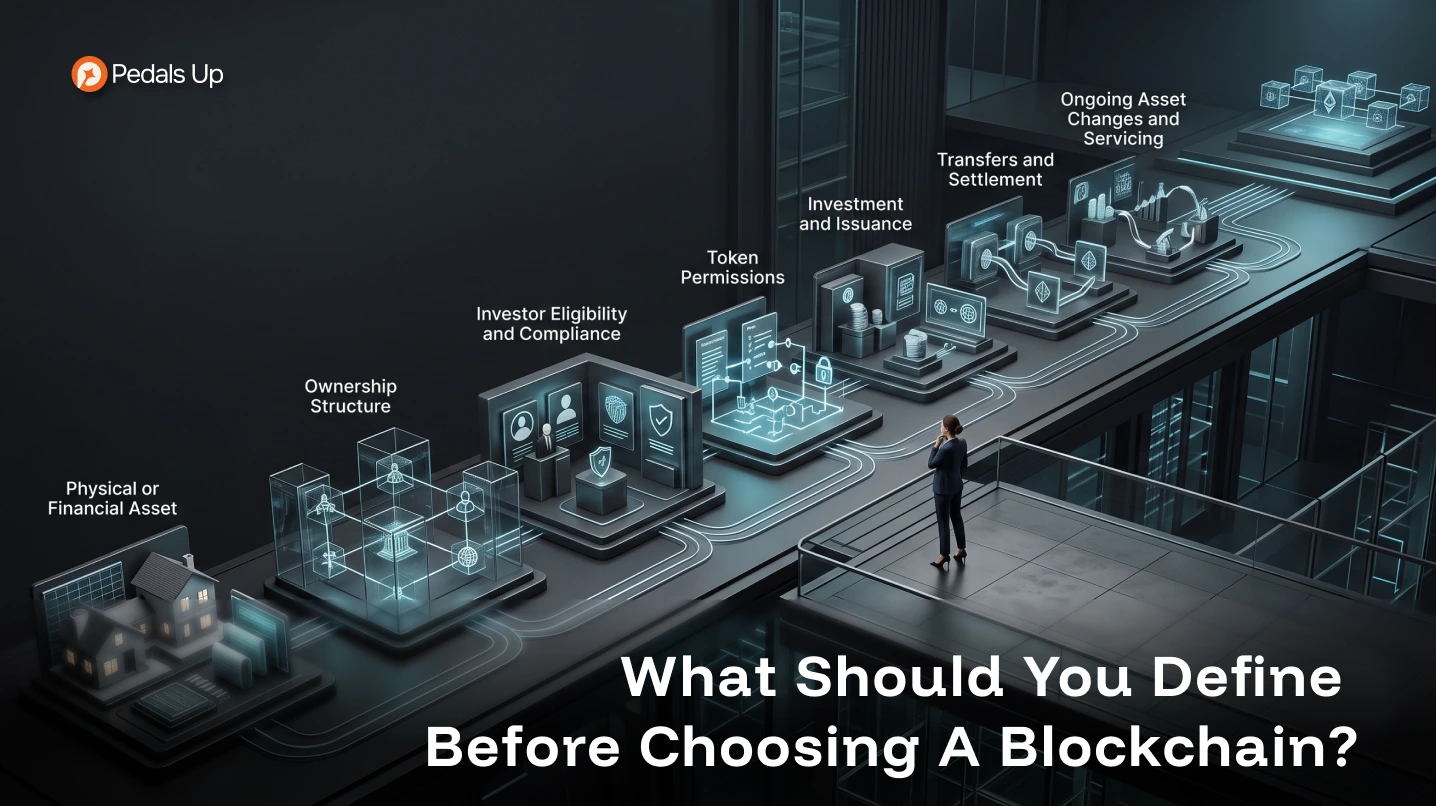
Start with the asset lifecycle. Answer these seven questions first:
- What exactly is the asset? Define what’s being represented and what off-chain data has to exist around it.
- What does ownership mean? Define the legal and economic rights the holder actually gets.
- Who can participate? Map identity, KYC/AML, and jurisdictional eligibility rules.
- What can the token do? Define holding, transfer, locking, and redemption restrictions.
- What happens after investment? Design distributions, corporate actions, and reporting.
- What happens when ownership changes? Define secondary transfers, wallet updates, and settlement.
- What happens when the underlying asset changes? Account for revaluations, refinancing, sale, or liquidation.
If these questions don’t have clear answers yet, choosing a blockchain network is premature. You’re still defining the product.
RWA products need product engineering, not only blockchain development
Blockchain development is an important part of an RWA platform. It isn’t the whole build. A production platform typically needs end-to-end product architecture, investor and admin applications, compliance workflows, banking integrations, data pipelines, and security controls, and the hard part is making all of it work together rather than building any one piece in isolation.
Pedals Up has worked on products across the RWA and real estate space, including Asset List, RealTokenize, Retok, and Vestra. Asset List is a data and analytics platform for discovering, analyzing, and tracking real-world and tokenized assets. RealTokenize focuses on tokenized real estate and digital ownership. Retok is focused on real estate and RWA tokenization. Vestra enables fractional real estate ownership through tokenization.
That range matters because RWA products sit across several disciplines at once. The engineering team needs to understand the product around the token, not only the token itself.
The value of tokenization is what the product enables
Tokenization can make ownership and transaction records programmable, and that’s genuinely useful. But the business value comes from what the surrounding product lets people do with that representation. Can an investor understand the asset and get through onboarding without friction? Can the platform enforce the right restrictions automatically? Can ownership be tracked, distributions calculated and paid, and permitted transfers completed? Can investors and operators see what they each need to see?
Those questions determine whether an RWA product works in practice. The token is one part of the answer. The product is the rest.
Conclusion
An RWA product is a lifecycle, not a token. If you’re planning one, the first technical conversation shouldn’t be about which blockchain to use. Start with the asset. Define the ownership model. Map the investor journey. Understand the rules around holding and transferring the asset. Then design what needs to happen after issuance.
Once those decisions are clear, the blockchain becomes what it should be: one engineering decision inside a larger product.
If you’re planning a tokenized asset, real estate, or RWA platform, we can help you work through the product architecture before development starts. Talk to Pedals Up about your RWA product.
Frequently Asked Questions
What’s the difference between tokenizing an asset and building an RWA product?
Tokenizing an asset is the technical process of creating a digital token that represents ownership or an economic interest in an asset. RWA product development includes everything around that token: asset records, legal structure, investor onboarding, compliance, ownership, transfers, payments, and reporting.
Do I need legal input before building an RWA platform?
Yes. The legal and economic structure should be understood before the technical architecture is finalized. What a token represents, who can hold it, what rights it carries, and how it can be transferred all depend on the product’s structure and applicable law.
Can smart contracts enforce who can hold a tokenized asset?
Smart contracts can enforce certain rules, including wallet allowlists and transfer restrictions, but they still need accurate identity and eligibility data fed in from an off-chain system. Permissioned token standards such as ERC-3643 and ERC-1400 build this connection into the token itself through an identity registry.
What’s the difference between on-chain and off-chain systems in an RWA platform?
On-chain systems typically handle token issuance, balances, and blockchain-recorded transfers. Off-chain systems typically handle investor records, asset information, compliance workflows, and payments. The two sides need to stay consistent with each other at all times.
How long does it take to build an RWA platform?
There’s no single useful timeline for every RWA product. Scope depends on the asset, legal structure, jurisdictions, banking integrations, and compliance complexity. Starting with a clear asset lifecycle definition gives the engineering team a much more accurate basis for estimating the build than starting with the blockchain.
Once those decisions are clear, the blockchain becomes what it should be: one engineering decision inside a larger product.
If you’re planning a tokenized asset, real estate, or RWA platform, we can help you work through the product architecture before development starts. Talk to Pedals Up about your RWA product.