AI Agents that do the work, not just answer
questions
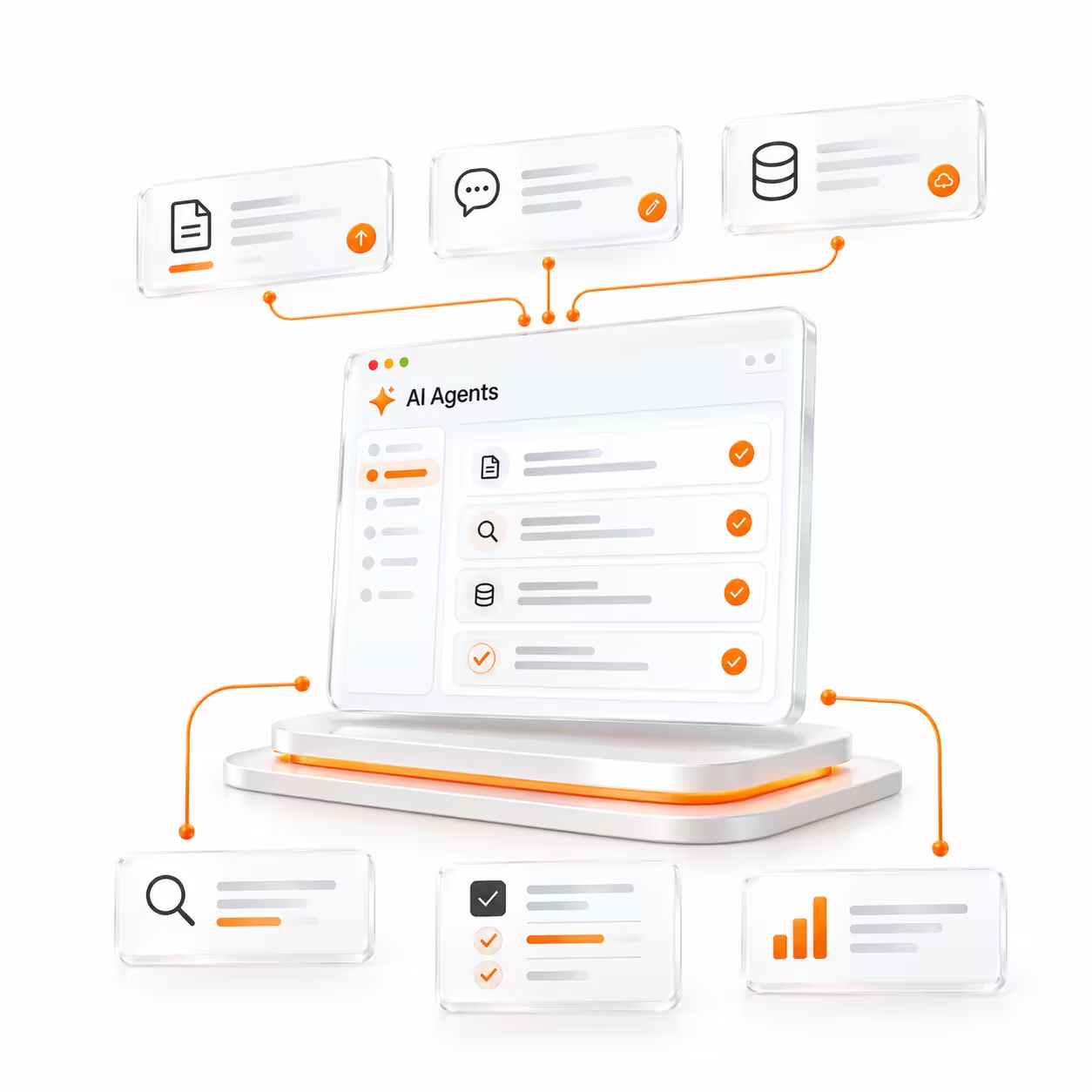
PedalsUp builds AI agents that can handle real tasks inside your business — across support, research, operations, internal workflows, and customer-facing processes. These are not generic chatbots. They are task-driven systems connected to your tools, grounded in your data, and designed to take useful action with the right controls in place.
Task-focused • Integrated with your tools • Human oversight where needed • Built to improve with use
Less Automation Theater. More Agents That Work.
A lot of AI agent projects fail because they try to automate too much, too early.They start with a broad assistant concept, skip the workflow detail, ignore the operational edge cases, and end up with something that can talk about the work but cannot reliably do the work. PedalsUp takes a different approach.We start with one real task, scope the agent around that job, connect it to the systems it actually needs, and build it with the controls, escalation logic, and monitoring needed to make it useful in practice.
Task-Specific Agents
We build agents designed around one job done well, rather than overpromising a general-purpose assistant that performs poorly across everything.
Tool and System Integration
Your agent connects into CRMs, databases, documents, APIs, and internal tools so it can take real action, not just produce text.
Human-in-the-Loop Controls
Where mistakes would be costly, we add approval steps, thresholds, escalation paths, and guardrails so the agent operates with appropriate control.
Monitoring and Iteration
Every action is tracked, reviewed, and improved over time so the system gets more useful through real usage rather than staying frozen at launch.
AI agents built around real workflows
We scope agents around the work the business actually needs done not around the most impressive possible demo.
Agents that help answer customer or internal support questions, retrieve information, route issues, draft responses, and reduce repetitive support workload without sacrificing control.
02
Research Agents
Research and analysis agents
Agents that gather, summarise, compare, and structure information across documents, databases, internal sources, or external inputs to support faster decision-making.
03
Operations Agents
Operational workflow agents
Agents that move work across tools, trigger steps, prepare output, update systems, and help teams execute repeatable operational processes with less manual effort.
04
Internal Knowledge Agents
Knowledge and retrieval agents
Agents that sit on top of your internal documents, SOPs, APIs, databases, and business knowledge to give teams faster answers grounded in your actual context.
05
Reporting and Coordination Agents
Reporting and workflow coordination agents
Agents that help prepare summaries, generate reports, track activity, surface exceptions, and keep information moving across teams more consistently.
06
Approval-Aware Agents
Agents with human review built in
For processes where trust and control matter, we design agents that pause for approval, flag edge cases, and escalate exceptions instead of acting blindly.
07
Multi-Step Task Agents
Agents that complete sequences, not just single prompts
Some tasks require retrieval, reasoning, execution, validation, and follow-up. We build agents that can work through that sequence in a structured, controlled way.
08
Embedded Product Agents
AI agents inside your product experience
Where it makes sense, we help embed agent behaviour directly into customer-facing or internal products so users get assistance and task execution without leaving the workflow.
Four steps. One trusted technical partner.
AI agents only become valuable when they are built around the job, tested against reality, and improved after launch.
Step 1
Define
Choose the task that is worth automating
We identify the specific workflow the agent should handle, the system context it needs, the boundaries it should operate within, and what success actually looks like.
Step 2
Build
Connect the agent to the tools and logic it needs
We build the agent, wire it into the right tools, data sources, and workflows, and define the rules, approvals, and action paths needed to make it usable.
Step 3
Test
Run it against real scenarios and edge cases.
Before anything goes live, we test the agent against realistic conditions to see how it behaves under ambiguity, exceptions, and imperfect inputs.
Step 4
Monitor
Improve performance through real usage.
Once deployed, we track what the agent does, where it performs well, where it struggles, and what needs refinement so the system gets stronger over time.
AI Agents
Start With One Task Done Well
You do not need to automate the whole business to get value from AI agents. You need one meaningful workflow, the right system design, and a team that can build it properly. Bring us one process worth automating. We’ll help turn it into something that actually works.
One successful agent is often the beginning, not the end.
Once one workflow proves the model, the next decisions become much easier.
Scale It Up
Expand the same agent into more tasks or launch additional agents for adjacent workflows where the same operational logic applies.
Plug it in further
Connect the agent more deeply into your systems, approvals, data layers, and cross-functional workflows as confidence grows.
Leave it focused
Sometimes one well-designed agent doing one job reliably is all the business needs. There is no pressure to expand beyond what creates real value.
Why teams trust PedalsUp, with AI agent delivery
Because agent projects fail when they are treated like demos instead of systems.
We scope the agent around the real job
We do not start with vague “assistant” language. We start with the specific task, context, decision path, and business outcome that make the workflow worth automating.
We connect the agent to actual systems
An agent that cannot access the right tools, data, or actions is just a chat interface. We build for integration from the start.
We design for control, not blind autonomy
Where risk matters, we include approvals, reviews, escalation logic, and operational guardrails so the agent behaves in a way the business can trust.
We are engineers first
PedalsUp’s AI positioning is execution-led. We build production-ready AI systems, not just high-level concepts or surface-level pilots
We improve the agent after launch
Real performance only becomes visible in live usage. We monitor behaviour, learn from edge cases, and refine the system based on what the work actually demands.
We know not every process should be automated the same way
Some tasks need full automation. Some need approvals. Some need knowledge grounding first. We help choose the right model instead of forcing the same pattern everywhere.
Question you might have,
Answers we definitely got
What is an AI agent?
An AI agent is a task-oriented system that can reason through a workflow, access the tools or information it needs, and take action toward completing a real job rather than only generating answers.
How is an AI agent different from a chatbot?
A chatbot usually responds to prompts. An AI agent is designed to complete tasks, interact with systems, follow workflow logic, and take useful action inside a business process.
What kinds of tasks are best for AI agents?
The best use cases are repeatable workflows with clear inputs, useful context, and defined outcomes — such as support routing, research preparation, reporting, knowledge retrieval, internal operations, and structured multi-step execution.
Do AI agents work with our existing tools?
Yes. We build agents to connect into the systems that matter, including internal databases, CRMs, documents, APIs, and workflow tools.
Can an AI agent take action without approval?
Sometimes yes, sometimes no. That depends on the task. Where the cost of error is high, we design approval gates, thresholds, and human review into the workflow.
What if we are not sure where an AI agent fits yet?
That is fine. In that case, AI Strategy & Roadmap or AI Quick Start may be the better first step before jumping into a full agent build.
Do you build one agent or multi-agent systems?
Both, depending on the workflow. But we usually recommend starting with one well-scoped agent first, proving value, and expanding from there
Can this turn into broader workflow automation?
Yes. In many cases, AI agents become the first layer in a wider automation strategy once the business sees where the model works best.
It's your time to grow
Put an AI agent to work on a real task.
If you have a process worth automating, a workflow that slows the team down, or a repetitive task that deserves a smarter system around it, start with a conversation. We’ll help you define the right agent, the right level of control, and the right path to getting it live.