
Table of contents
Top Use Cases for Agentic RAG in Ecommerce: A Practical Guide
A customer searching for running shoes rarely knows every specification they need. They might want something comfortable for daily use, suitable for flat feet, available in their size, and deliverable before the weekend. Traditional ecommerce search expects them to translate those requirements into keywords and filters.
Agentic RAG in ecommerce offers a different approach. Instead of simply matching products to search terms, an AI assistant can interpret the customer’s needs, retrieve relevant product information, compare alternatives, check availability, and guide the next step.
For ecommerce businesses, the opportunity extends beyond conversational shopping. The same approach can improve customer support, order management, returns, and internal operations. But its value depends on how well the AI connects with the systems already running the store.
What Is Agentic RAG in Ecommerce?
Agentic RAG combines retrieval-augmented generation with AI agents capable of planning and performing multiple steps to answer a request.
Traditional RAG retrieves relevant information from a knowledge source and uses it to generate an answer. Agentic RAG can decide which sources to consult, break complex requests into smaller tasks, retrieve additional information, and use connected tools when necessary.
Consider a customer asking whether a particular laptop supports video editing, fits their budget, and can arrive by Friday.
A conventional chatbot might explain the laptop’s specifications. An Agentic RAG system could compare technical requirements, search the catalog, check current prices, verify delivery eligibility, and recommend suitable alternatives.
The distinction matters because ecommerce decisions often depend on information distributed across product catalogs, inventory systems, shipping services, and customer accounts.
However, retrieval and action are different capabilities. An agent should not modify an order or initiate a refund simply because it can retrieve the relevant policy.
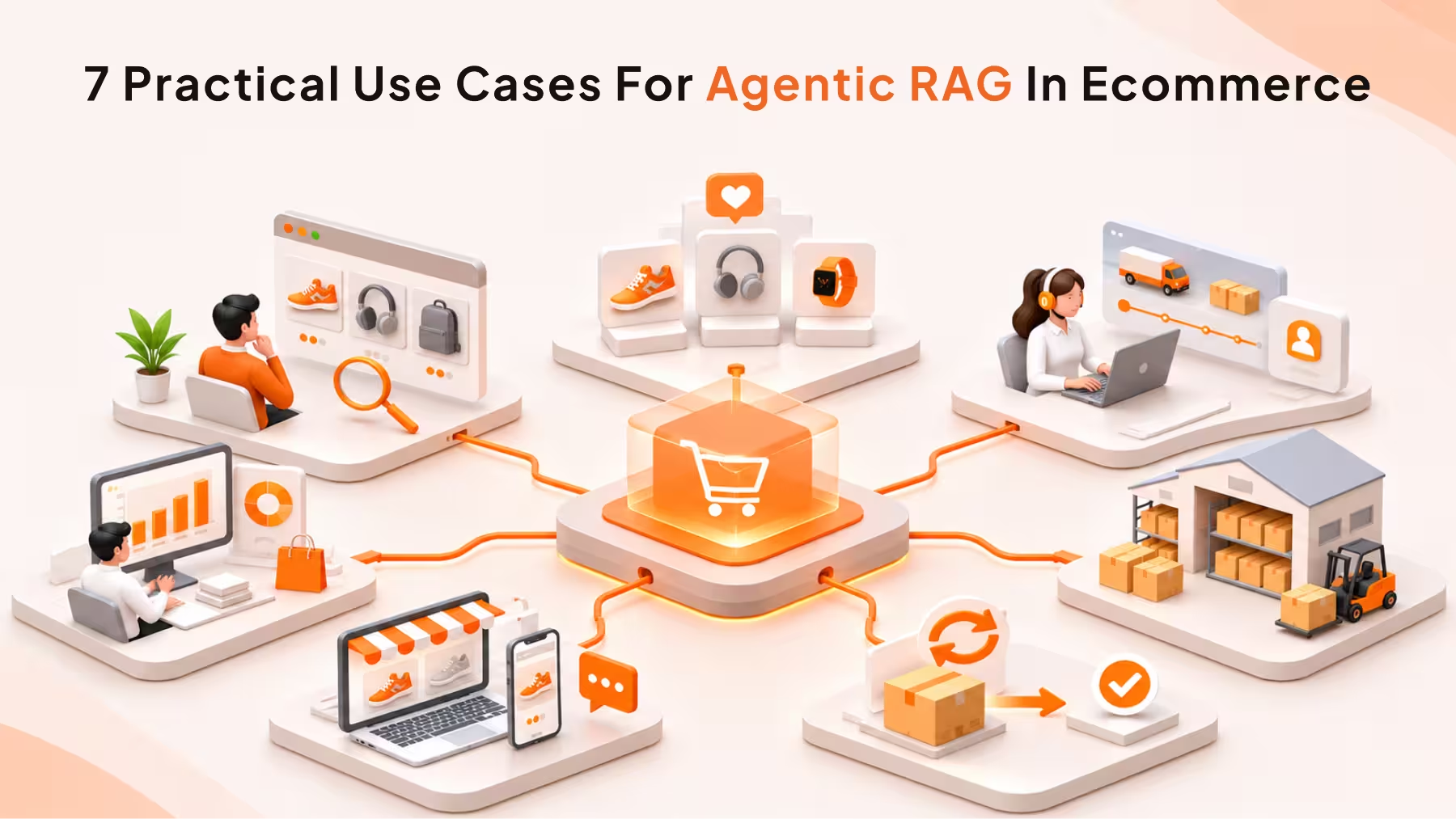
7 Practical Use Cases for Agentic RAG in Ecommerce
1. Conversational Product Discovery
Product discovery is one of the strongest starting points for Agentic RAG because shoppers frequently describe needs rather than exact products.
Someone shopping for skincare might request a fragrance-free moisturizer suitable for sensitive skin within a particular budget. A conventional search engine may return products containing similar keywords without understanding the full requirement.
An Agentic RAG assistant can interpret the constraints, retrieve product attributes, filter unsuitable options, and ask clarifying questions when important information is missing.
This becomes especially useful for electronics, beauty, home improvement, automotive accessories, and other categories where customers need help evaluating compatibility or specifications.
The business objective is not merely more conversations. Retailers should measure whether assisted shoppers find relevant products faster, add suitable items to their carts, and complete purchases.
2. Personalized Product Recommendations
Many ecommerce recommendation systems rely on browsing history, previous purchases, or patterns observed among similar customers.
Agentic RAG adds conversational context to those signals.
Imagine a customer buying furniture for a small apartment. They have previously viewed compact desks but now mention needing storage, cable management, and enough space for two monitors.
An AI assistant can combine those stated requirements with available product information to produce a more relevant shortlist. It can also explain the trade-offs between alternatives rather than presenting unrelated recommendations.
Personalization requires boundaries. Customer data should be accessed only with appropriate permissions, and recommendations should not invent product capabilities or imply compatibility that has not been verified.
For retailers, useful measurements include recommendation acceptance, assisted conversion, returns associated with unsuitable recommendations, and customer satisfaction.
3. Customer Support That Understands Orders
Customers often contact support because information exists somewhere in the business but is difficult to access.
A shopper might ask why an order has not arrived, whether a replacement is available, or whether a delayed shipment can be redirected.
A properly integrated agent can retrieve relevant shipping policies, access authorized order information, consult carrier updates, and explain the available options.
Where permitted, it can also initiate a predefined support workflow or escalate the issue to a human representative.
This is more useful than a chatbot that repeatedly provides generic delivery policies.
However, account verification must happen before revealing private order details. Order changes should pass through the commerce platform’s authorization and validation rules rather than relying on the language model’s judgment.
The strongest success metric is verified issue resolution, not simply the number of conversations handled without human intervention.
4. Inventory-Aware Shopping Assistance
A recommendation loses value when the product is unavailable.
Agentic RAG can connect product discovery with inventory and fulfillment systems, helping customers find alternatives that are actually purchasable.
For example, a shopper looking for a specific jacket may discover that their preferred size is unavailable locally. The assistant could check other fulfillment locations, identify comparable products, and explain available delivery options.
For retailers operating multiple stores or warehouses, this can make existing inventory easier to discover.
The important engineering distinction is that stock availability should come from an authoritative inventory service, not an old document stored in a vector database.
Availability can change between recommendation and checkout. The commerce platform must therefore revalidate stock before accepting the order.
5. Smarter Returns and Exchange Assistance
Returns are another area where customer questions frequently involve several systems.
A customer requesting an exchange may need information about return eligibility, purchase dates, product condition, replacement availability, and collection arrangements.
An Agentic RAG assistant can retrieve the relevant policy, check authorized order details, identify available exchange options, and guide the customer through the process.
For straightforward requests, it may initiate a return workflow after the required checks and confirmation.
Exceptions should remain controlled. High-value refunds, suspected fraud, policy disputes, and unusual circumstances may require human approval.
A successful implementation should reduce unnecessary support work without increasing incorrect refunds, customer disputes, or operational losses.
6. Shopping Assistance Across Multiple Channels
Ecommerce customers increasingly interact with brands through websites, mobile applications, messaging platforms, and support channels.
Agentic RAG can provide a consistent information layer across these experiences.
A customer might begin researching a product on the website and later ask a related question through a messaging channel. With appropriate identity verification and consent, the assistant could retain relevant context and continue the conversation.
This does not require every channel to share unrestricted customer data. Identity, permissions, and conversation history must be handled deliberately.
The practical benefit is continuity. Customers should not need to explain their requirements repeatedly simply because they changed channels.
7. Internal Ecommerce Operations and Merchandising
Agentic RAG is not limited to customer-facing experiences.
Merchandising teams regularly work across product information systems, supplier documentation, sales reports, and operational policies.
An internal assistant could help investigate why certain products have high return rates, identify missing catalog attributes, or compare supplier information before a purchasing decision.
For instance, a merchandising manager could ask which products generate frequent sizing complaints and whether their descriptions contain sufficient measurements.
The agent could retrieve relevant reviews, return reasons, and catalog records to support an investigation.
These systems should present traceable evidence rather than invent explanations. Business decisions involving pricing, supplier commitments, or inventory purchases still need appropriate approval.
When Does Agentic RAG Make More Sense Than Traditional RAG?
Not every ecommerce problem requires an AI agent.
A customer asking about shipping charges, return windows, or basic product specifications can often be served effectively through conventional search, traditional RAG, or predefined automation.
Agentic RAG becomes more valuable when a request requires several information sources, changing business data, or decisions that depend on earlier results.
For example, answering a question about a store’s return policy is straightforward retrieval. Determining whether a specific order qualifies for an exchange, checking replacement inventory, and preparing the next action involves a more complex workflow.
The additional intelligence also introduces costs. Multiple retrieval operations and model calls can increase response time, infrastructure spending, and opportunities for errors.
Retailers should therefore choose the simplest architecture that reliably solves the customer’s problem.
What Ecommerce Businesses Need Before Implementing Agentic RAG
Successful implementation depends more on reliable commerce infrastructure than on choosing the most advanced language model.
Product data must be sufficiently complete and structured. Prices, product variants, inventory, and delivery promises need authoritative sources. Customer information requires controlled access, while order-changing actions need explicit validation.
A practical architecture combines structured catalog filtering with semantic retrieval, connected commerce APIs, and carefully restricted agent tools.
This approach is reflected in Intercom’s research on structured Agentic RAG for ecommerce, which explains why product catalogs require more than conventional document retrieval.
/research
Similarly, AWS’s technical shopping agent example demonstrates how search infrastructure, agent orchestration, and connected tools can support product discovery.
AWS Big Data Blog
Before deployment, businesses should test product accuracy, response latency, incorrect recommendations, permission handling, and failed API calls. These evaluations matter as much as the quality of the conversation itself.
How to Choose the Right Starting Point
The best first use case is usually a frequent customer problem with measurable impact and accessible, trustworthy data.
For a retailer with a complex catalog, conversational product discovery may be a sensible starting point. For a business overwhelmed by repetitive order inquiries, support automation may deliver clearer operational value.
Start with a limited product category or support workflow. Establish baseline performance, test the assistant against real customer questions, and compare outcomes before expanding its responsibilities.
A useful pilot should demonstrate whether the system improves customer decisions or reduces operational effort without introducing unacceptable risk.
Building Better Ecommerce Experiences With PedalsUp
Agentic RAG creates value when it helps customers make better purchasing decisions and enables retailers to manage complex interactions reliably.
The real investment is not simply an AI assistant. It is the connection between customer intent, accurate commerce information, and business processes that can be trusted.
PedalsUp brings together AI development and ecommerce product engineering to help businesses evaluate these opportunities and build practical solutions. Explore our product engineering and AI development services or our ecommerce development capabilities to discuss an architecture review or focused implementation pilot.