
Table of contents
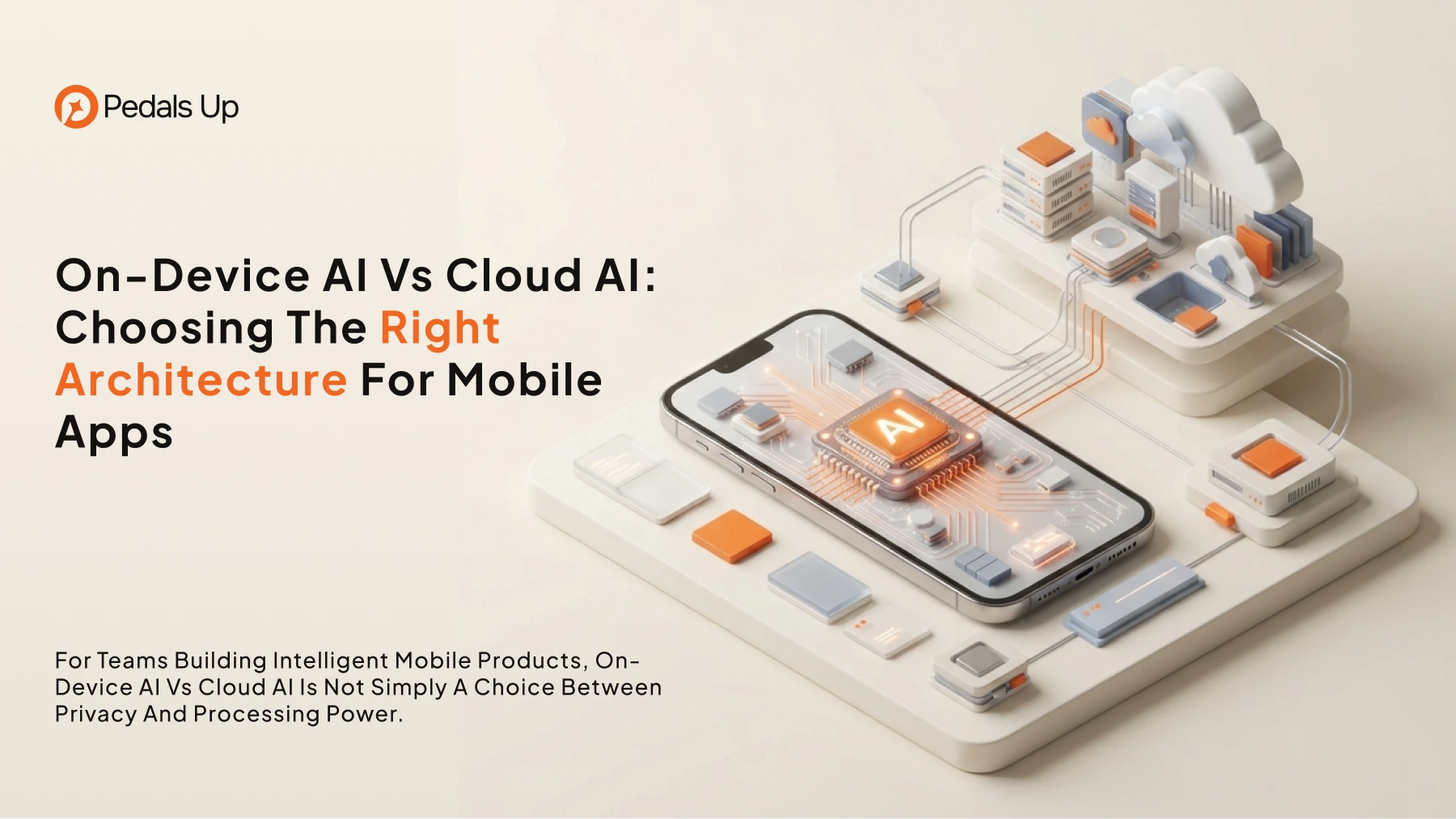
On-Device AI vs Cloud AI: Choosing the Right Architecture for Mobile Apps
An AI feature can work perfectly in a product demo and still become a problem after launch. A customer loses connectivity, an older phone cannot run the model, or inference costs rise faster than subscription revenue.
For teams building intelligent mobile products, on-device AI vs cloud AI is not simply a choice between privacy and processing power. It determines which users can access a feature, how consistently it performs, and who pays for every interaction.
What Is the Difference Between On-Device AI and Cloud AI?
On-device AI executes machine learning inference locally, using a smartphone’s processor or dedicated accelerators. Inputs can be processed without sending them to a remote inference service. Depending on the model and application, features such as text classification, image recognition, transcription, and summarization may work without an internet connection.
Cloud AI sends information to a remote service that runs the model and returns a result. This allows applications to access larger models, centralized data, and substantial computing resources without requiring powerful hardware from every user. It also introduces network dependency, service costs, and additional data handling responsibilities.
Why the Decision Matters More Than Model Quality
A model’s benchmark score tells you little about whether its deployment fits your customers. A slightly less capable local model may deliver a better experience for a warehouse worker with unreliable connectivity. A cloud model may be preferable for a financial analyst whose task requires extensive documents, current account information, and careful reasoning.
Four constraints usually determine the answer: task complexity, supported devices, response time, and data sensitivity. Cost becomes decisive once usage patterns are understood.
Performance Is About the Complete Interaction
Local inference avoids a network round trip, but it is not automatically faster. Model loading, available memory, device temperature, and output length affect response times. A compact model on a recent flagship phone may perform differently on an older supported device.
Cloud inference adds network latency but may complete demanding workloads faster on specialized infrastructure. Teams should measure time to first useful result and time to completed task, not merely model execution time.
Privacy Depends on the Entire Data Path
Local processing can reduce the need to transmit sensitive inputs. That is useful for personal notes, images, and certain enterprise workflows. However, it does not automatically make an application private or compliant.
Analytics SDKs, crash reports, backups, synchronization, and downstream APIs may still transmit information. Cloud processing can also be designed with appropriate access controls, retention limits, encryption, and contractual safeguards.
Map every place where data is collected, stored, processed, or transferred. Privacy claims should describe actual system behavior rather than the location of a single model.
What Apple and Google Actually Support
The ecosystem has moved beyond experimental demonstrations, although compatibility remains a significant limitation.
Apple’s Foundation Models framework gives developers access to models for tasks including language understanding, structured output, and tool use. Its on-device capabilities depend on Apple Intelligence-compatible hardware and software. Apple’s documentation also describes options for more demanding server-based processing. Developers therefore need an eligibility check and an alternative experience for unsupported devices.
On Android, Google’s ML Kit GenAI APIs use Gemini Nano through AICore for supported on-device tasks. Google’s documentation covers capabilities including summarization, rewriting, image description, and direct model access. Support varies by device and feature, so an Android version number alone cannot establish availability.
There are operational restrictions too. Google documents foreground execution requirements and inference quotas for its GenAI APIs. Certain direct model access capabilities are offered in beta, while agentic workflows remain in preview. These distinctions matter when planning a production roadmap rather than a prototype.
Apple Developer Documentation+3
When On-Device AI Is the Better Choice
Local inference is particularly useful when a task is narrow, repeated frequently, and must remain responsive without dependable connectivity.
Consider a hypothetical field service application used by technicians inspecting equipment. It could classify photographs locally, flag missing form fields, and prepare short summaries before synchronizing completed reports. The technician can continue working in areas with weak reception, and the application avoids sending every intermediate interaction to a server.
The tradeoff is maintenance. Models may need downloading, version management, compatibility testing, and safeguards against excessive battery or memory use. Teams must also decide what happens when a model is unavailable, its output is uncertain, or the device cannot complete inference.
On-device AI reduces some server costs. It does not eliminate engineering costs.
When Cloud AI Makes More Sense
Cloud inference is often preferable when the application requires complex reasoning, substantial context, frequently updated knowledge, or consistent capability across a broad range of phones.
Imagine a mobile assistant that analyzes a company’s contracts against current policies and retrieves information from several internal systems. The workload may require centralized authorization, retrieval infrastructure, audit logging, and a model too demanding for typical smartphones.
Cloud deployment also makes model changes easier to coordinate. Teams can evaluate a new version, adjust routing, and roll back problems without waiting for every customer to update an application. That control is especially valuable when output quality changes have business consequences.
However, cloud architectures require attention to provider outages, rate limits, unpredictable traffic, data residency, and inference spending. Caching, request limits, smaller models, and sensible output constraints can improve economics without compromising the product’s purpose.
The Hybrid Architecture Question Most Teams Miss
Hybrid AI combines local and remote processing, but simply adding both does not create a sound architecture. The difficult part is deciding who owns each task and what happens when execution moves between environments.
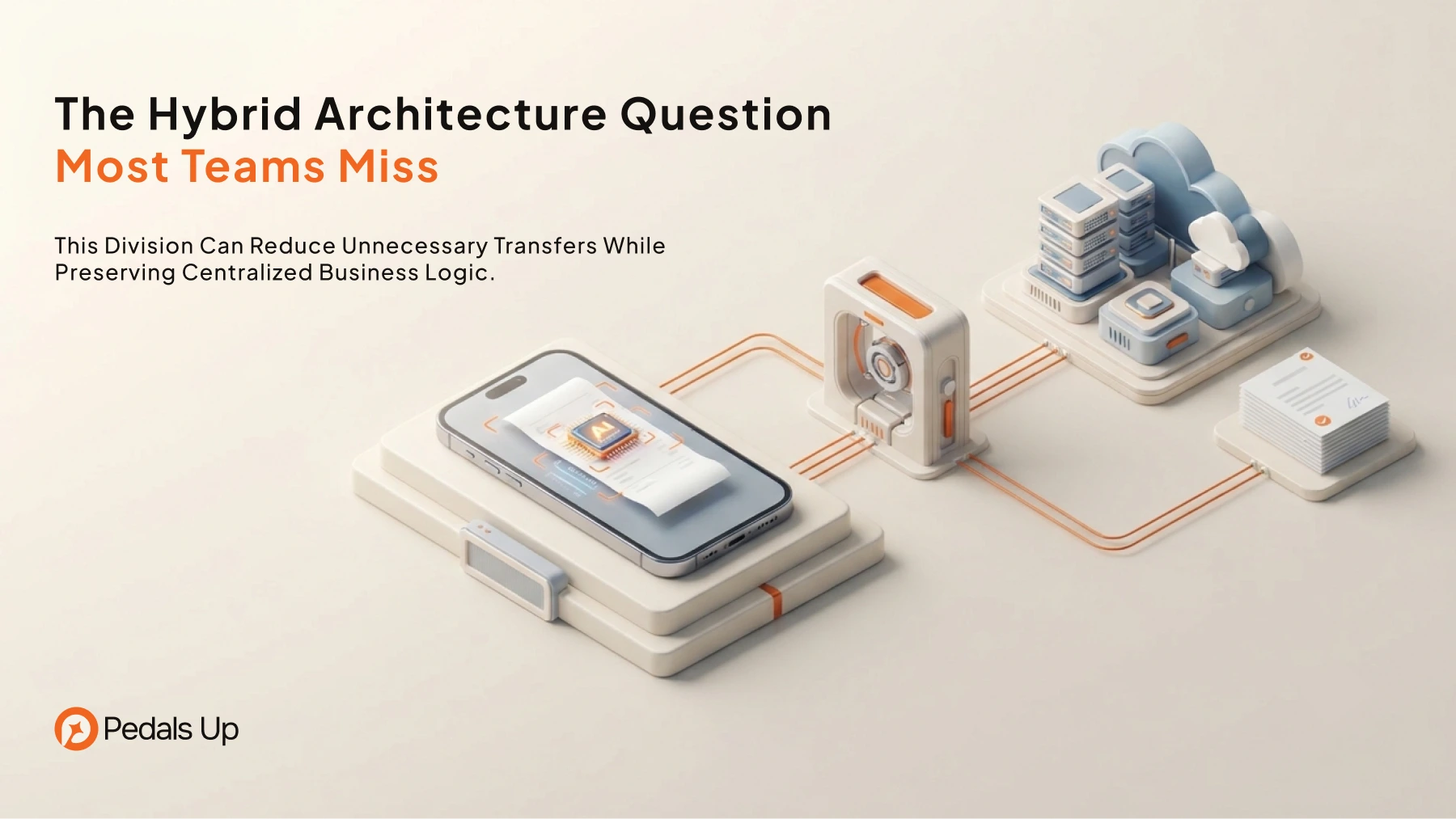
Consider a hypothetical expense management app. It could detect document boundaries and extract preliminary fields locally. A cloud service might then validate extracted information against company policy and accounting records. This division can reduce unnecessary transfers while preserving centralized business logic.
But there is a hidden dependency: the two stages must agree on data formats, confidence thresholds, and error handling. If local extraction produces an incorrect amount, the cloud may confidently validate the wrong information.
A useful design includes explicit validation between stages, visible review for uncertain results, and rules governing when cloud fallback is permitted. It should also specify whether a failed cloud request is queued, retried, or returned to the user for action.
The most important hybrid decision is therefore not where inference runs. It is where responsibility for correctness sits.
How to Choose an Architecture Before Development
Start with a representative task rather than selecting a model provider. Describe the input, expected output, acceptable error rate, maximum waiting time, and consequences of failure.
Next, examine the devices your customers actually use. A feature restricted to premium hardware may be reasonable for a controlled enterprise fleet but unsuitable for a mass-market consumer app. Establish the supported-device percentage before treating local inference as the default.
Then test three options using the same realistic inputs: a local model, a cloud model, and a hybrid workflow where appropriate. Measure task success, end-to-end latency, battery impact, network consumption, and failure recovery.
Cost comparisons should include more than API pricing. Estimate cloud inference at expected usage volumes, then compare it with local integration, device testing, model distribution, and ongoing maintenance. For hybrid systems, account for both sets of responsibilities.
Finally, define a fallback policy. A feature should not silently switch from local processing to cloud processing when that changes how personal information is handled.
Questions Product Leaders Should Ask
Can on-device AI work completely offline?
Yes, if the required model and resources are already available locally and the task does not depend on remote information. Initial downloads, authentication, synchronization, and certain integrations may still require connectivity.
Is on-device AI always cheaper than cloud AI?
No. Local inference avoids per-request cloud inference charges, but compatibility work, model management, testing, and support can outweigh those savings for low-volume products. Compare total ownership costs against realistic usage.
Should every mobile app use a hybrid model?
No. Hybrid systems add routing, testing, monitoring, and failure handling. If one deployment approach meets the product’s requirements, unnecessary complexity offers little value.
Build Around the User, Not the Model
The strongest mobile AI architecture is the one that delivers dependable outcomes across the devices, networks, and operating conditions your customers actually face. Sometimes that means keeping inference local. Sometimes it means investing in cloud capabilities. Often, the answer is a carefully bounded combination.
At PedalsUp, we approach these decisions as product engineering problems rather than model selection exercises. If you are planning an AI-enabled mobile application or upgrading an existing product, explore our product engineering and AI development services and discuss an architecture review before implementation decisions become expensive to reverse.