
Table of contents
How Booking.com Uses AI and What It Takes to Build a Similar Platform
Booking.com did not become an AI-powered travel business by placing a chatbot over hotel listings. It connected conversational discovery to years of investment in recommendations, property information, and booking infrastructure. For founders considering an AI-powered travel booking platform, that is the important lesson: a convincing conversation is easy to demonstrate; a trustworthy reservation is considerably harder to deliver.
A focused travel product can use the same engineering principles without needing the same scale.
How Booking.com's AI evolution unfolded
Booking.com was applying machine learning to recommendations before generative AI became widely available. In June 2023, it introduced an AI Trip Planner in beta for selected US app users. The experience combined existing recommendation systems with OpenAI language models, allowing travelers to describe destinations, refine preferences, and move from suggested accommodation into the established booking flow.
Booking.com did not ask a language model to become its inventory database or payment processor. The model helped interpret requests while established services supplied travel options and handled reservations.
In October 2024, Booking.com announced Smart Filter and Property Q&A. Smart Filter translated descriptions into relevant accommodation filters; Property Q&A drew on property information and reviews to address specific concerns. Review Summaries were being tested at the time, rather than universally available. OpenAI’s published account also describes how Booking.com developed an initial trip-planning prototype in ten weeks by connecting models to existing infrastructure.
That ten-week figure is a prototype milestone, not a benchmark for building a marketplace from scratch. Booking.com already had supplier relationships, property data, engineering teams and functioning transactions. More recently, its 2026 investor commentary described testing a discovery experience combining flight prices, traveler reviews and AI-generated destination insights. The direction is clear: AI is moving closer to decisions throughout the journey, not merely answering general travel questions.
What an AI travel platform actually needs
A traveler might ask for a quiet seaside hotel suitable for two children, within a particular budget, with free cancellation. A conversational model can identify the destination, dates, occupancy, and preferences, then ask for missing details. But it cannot reliably decide which rooms are available or what the final charge will be without consulting authorized systems.
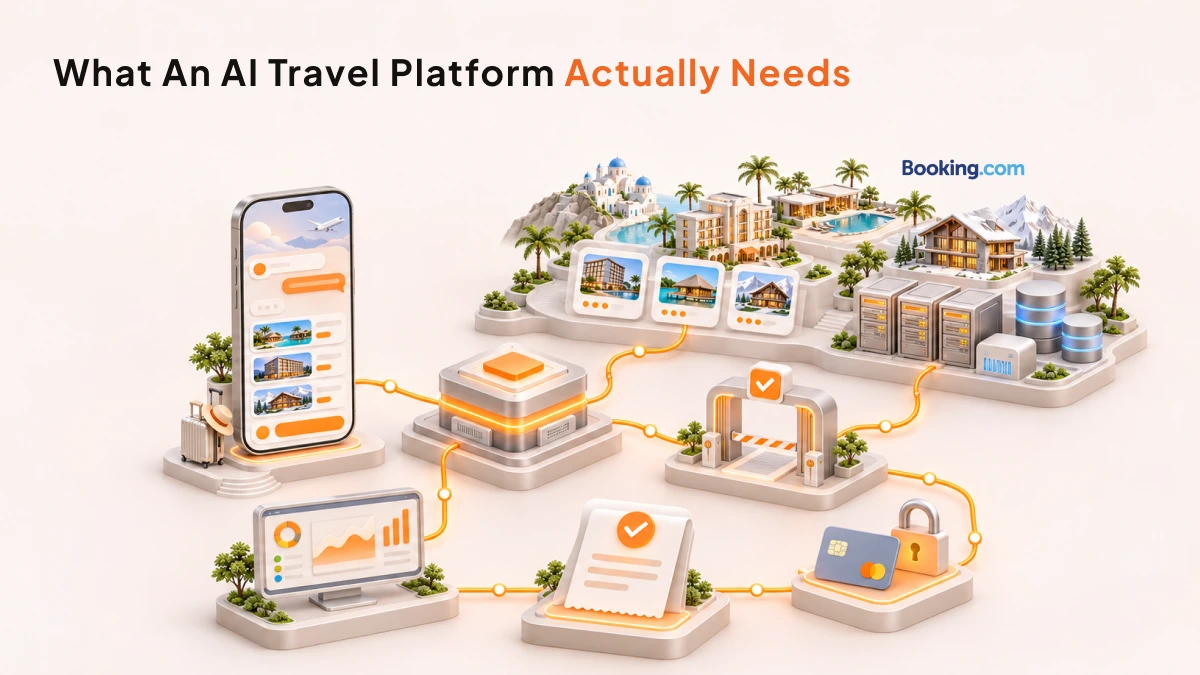
A practical architecture separates responsibilities. The interface manages conversation, results, comparisons, and checkout. An AI orchestration service converts intent into approved search requests. A supplier integration layer retrieves property details, rates, availability, and booking conditions. A transaction service handles reservations, payment states, confirmations, and cancellations. Monitoring connects these layers so failures can be investigated.
The AI should explain options using returned facts, not invent them. If a supplier has not confirmed wheelchair accessibility or pet restrictions, the interface should say the information is unavailable rather than confidently guess.
Retrieval and live inventory solve different problems
Retrieval-augmented generation can ground answers in destination guides, approved property descriptions and policy documents. It is useful for questions about neighborhoods, facilities and travel requirements. Yet a stored document cannot establish whether a room remains available at a particular price.
For changing facts, the application needs live supplier requests. Booking.com’s Demand API documentation, for example, describes accommodation search using dates, guest counts, location and other filters. Supported responses can contain prices, policies, and product details. A separate order preview validates booking information before an order is created.
Start with the business model, not the chatbot
There are three fundamentally different products a founder might build. A travel discovery assistant recommends destinations and sends users elsewhere to book. A niche booking product offers selected inventory and a controlled purchase journey. A broader marketplace combines multiple suppliers, payments, customer support, and ongoing reservation management.
The second provides a stronger opportunity to own customer experience while limiting scope. The third demands more integrations, supplier operations, and working capital, especially when the business collects payments or manages refunds.
Booking.com’s Demand API itself illustrates these choices. Its documentation describes content-only, search-and-redirect, and supported search-and-book integration flows. Access depends on partner eligibility, service, and API capabilities; publishing an API reference does not mean any startup can immediately sell every listed travel product.
For most early-stage teams, a specific audience offers a better opening than a generic hotel marketplace. Accessible stays, regional adventure travel, or company retreats each create distinct requirements that a focused product can address.
The engineering decisions that determine reliability
Supplier integration is usually more difficult than connecting an LLM. Properties may have different identifiers across sources, inconsistent room labels, and cancellation policies that cannot be compared directly.
Price verification is another critical boundary. A result displayed during discovery may change before checkout. The system should refresh availability, show the final payable amount, and require customer confirmation before creating an order. Booking.com’s documented preview-and-create pattern is a useful reference, although implementation details depend on the supplier and agreement. Reservation state needs equal care. Imagine a supplier confirms a room, but the payment service times out before the application receives its response. Retrying blindly could create duplicate reservations or charges. Idempotency controls, reconciliation jobs, and an operational dashboard help teams determine what happened before taking another action.
Minimize personal information sent to AI services, restrict which tools an assistant may call, keep payment credentials out of prompts, and preserve auditable records of consequential actions. Human support should remain available when bookings, cancellations, or refunds become ambiguous.
Which AI features belong in the first release?
Natural-language filtering is a sensible early feature because it can translate a customer’s request into explicit search criteria. Property questions are another option when answers can be traced to approved source material. Personalized ranking may help later, once the platform has enough relevant interaction data to evaluate whether recommendations improve outcomes.
Autonomous booking deserves more caution. Letting an agent select and purchase travel without a clear confirmation boundary introduces financial and customer-service risks. A safer design lets AI prepare a shortlist and explain trade-offs while the customer approves the exact offer and payment terms.
Consider a hypothetical corporate retreat platform. Its first version could gather dates, group size, meeting-room requirements, and budget, then present verified properties and an inquiry or booking path. It would not need flight disruption management, dynamic packages, or a general travel agent.
What will development cost?
A planning assistant with outbound referral links has a smaller technical and operational footprint than a platform processing reservations. Adding several suppliers increases mapping, testing, and support work. Operating across countries adds currencies, taxes, localization, consumer obligations, and payment complexity.
The highest hidden cost may be exceptions rather than normal bookings. Every failed payment, disputed cancellation, changed room rate, or unmatched supplier record can require human intervention. Estimate support effort and failure recovery alongside infrastructure and model usage.
Founders should evaluate unit economics before choosing an architecture: expected searches per booking, commission or margin per completed transaction, acquisition cost, AI inference cost, and support cost. A system that generates attractive itineraries but produces expensive, low-converting searches may not support a viable business.
Avoid treating published development estimates as universal quotes. Supplier contracts, inventory coverage, booking ownership, and compliance requirements can change both scope and schedule substantially. Discovery should establish these dependencies before a team commits to a delivery plan.
A practical roadmap for building your platform
First, validate the customer segment and inventory strategy. Identify who supplies the travel products, whether bookings happen on your platform, and what differentiates the offer. Confirm API access and commercial conditions early; supplier approval can become a delivery dependency.
Second, build the transaction path without generative AI. Make search, offer validation, booking confirmation, notifications, and cancellation handling work reliably. Test timeouts, changed prices, unavailable inventory, and repeated requests.
Third, add AI to one measurable friction point. Start with conversational filters or grounded property questions. Test ambiguous prompts, missing information, and contradictory policies. Evaluate the system on factual accuracy and task completion, not whether the answers sound natural.
Finally, measure business outcomes. Track search-to-detail engagement, quote-to-booking conversion, booking failures, support contacts, refunds, and cost per completed reservation.
The lesson founders should take from Booking.com
Booking.com’s advantage is not a particular chatbot interface. It is the connection between customer intent, extensive travel information, and a booking journey designed to complete real transactions. A new business can adopt that principle while serving a narrower market with a more focused product.
At PedalsUp, we approach AI products as engineering systems, not isolated model demonstrations. If you are evaluating a travel booking platform, explore our AI services and begin with an architecture review covering supplier access, transaction ownership, operational risks, and the smallest viable release. Build the reliable booking experience first. Add intelligence where it makes the customer’s decision easier.