Table of contents
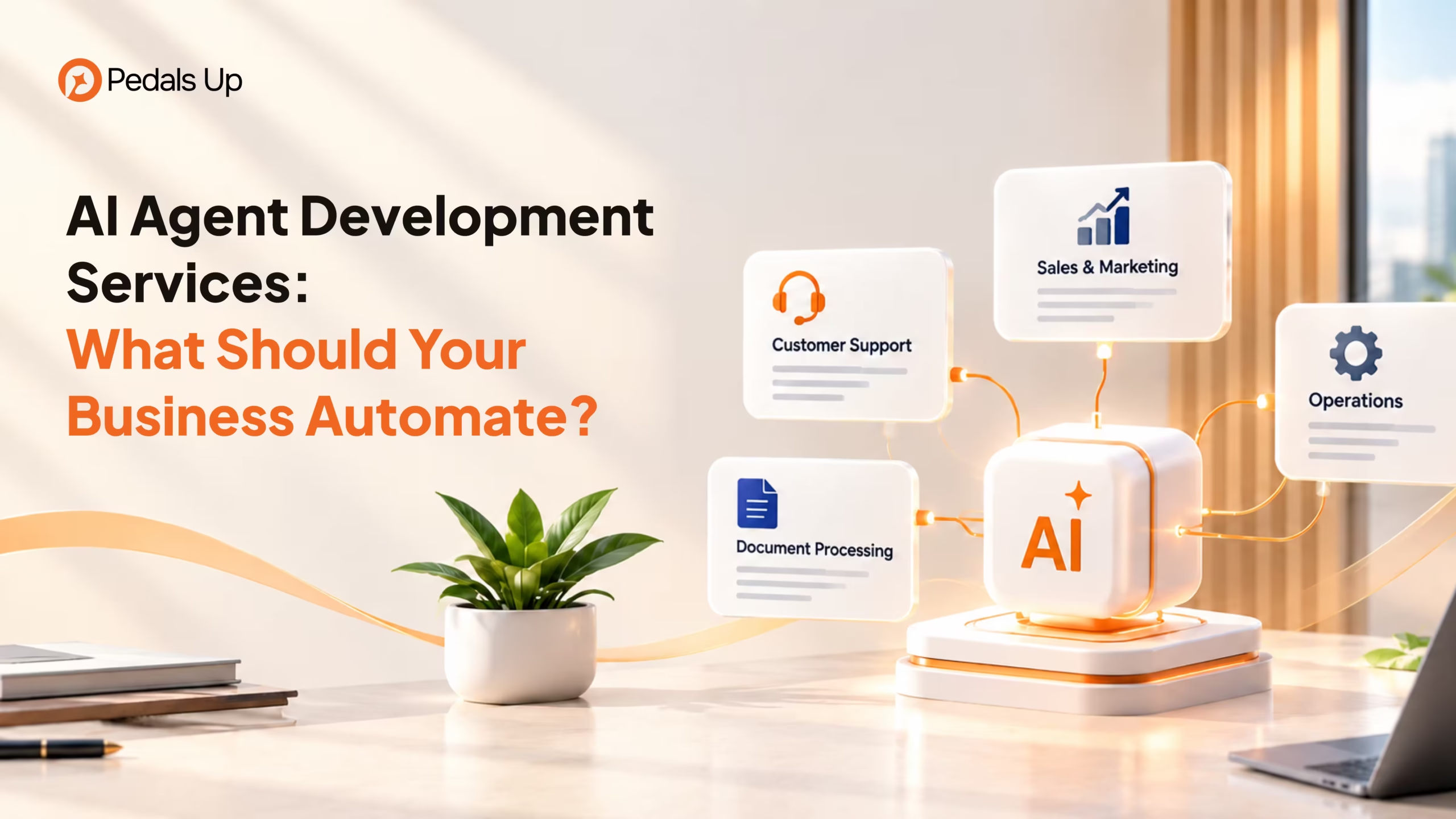
AI Agent Development Services: What Should Your Business Automate?
The easiest part of building an AI agent is getting it to perform a task in a demo. The harder part is deciding whether that task should have been given to an AI agent in the first place.
Businesses are finding plenty of opportunities to use AI. Customer support teams want faster resolutions, sales teams want fewer manual follow-ups, and operations teams want software that can handle work across different applications. Yet the discussion often jumps straight to development before anyone examines how the process actually works.
That is where many AI investments become unnecessarily complicated.
AI agent development services can help businesses automate workflows that require reasoning, contextual decisions, and interaction with multiple systems. But those capabilities come with engineering costs and operational responsibilities that conventional automation doesn’t always require.
The opportunity is real. The challenge is knowing where to use it.
The Automation Problem Most Businesses Misdiagnose
Imagine a finance department that spends hours reviewing invoices.
Some invoices arrive in standard formats, contain complete information, and match existing purchase orders. Others include unexpected charges, missing references, or discrepancies that require investigation.
Automating both situations using the same approach would be a mistake.
The first process can usually be handled through established rules and software integrations. The second requires interpreting information, checking supporting records, and determining what needs attention.
An AI agent could assist with that investigation by retrieving relevant documents, comparing details, and preparing recommendations for an employee.
This distinction matters because repetitive work and intelligent work are not necessarily the same thing.
Traditional automation is effective when instructions are predictable. AI agents become useful when the next step depends on information that changes from one situation to another.
Microsoft makes a similar distinction in its guidance on AI agent adoption, recommending conventional software for predictable tasks and agents for workflows involving contextual reasoning and multiple decisions.
For business leaders, that suggests a different starting point: examine the work before selecting the technology.
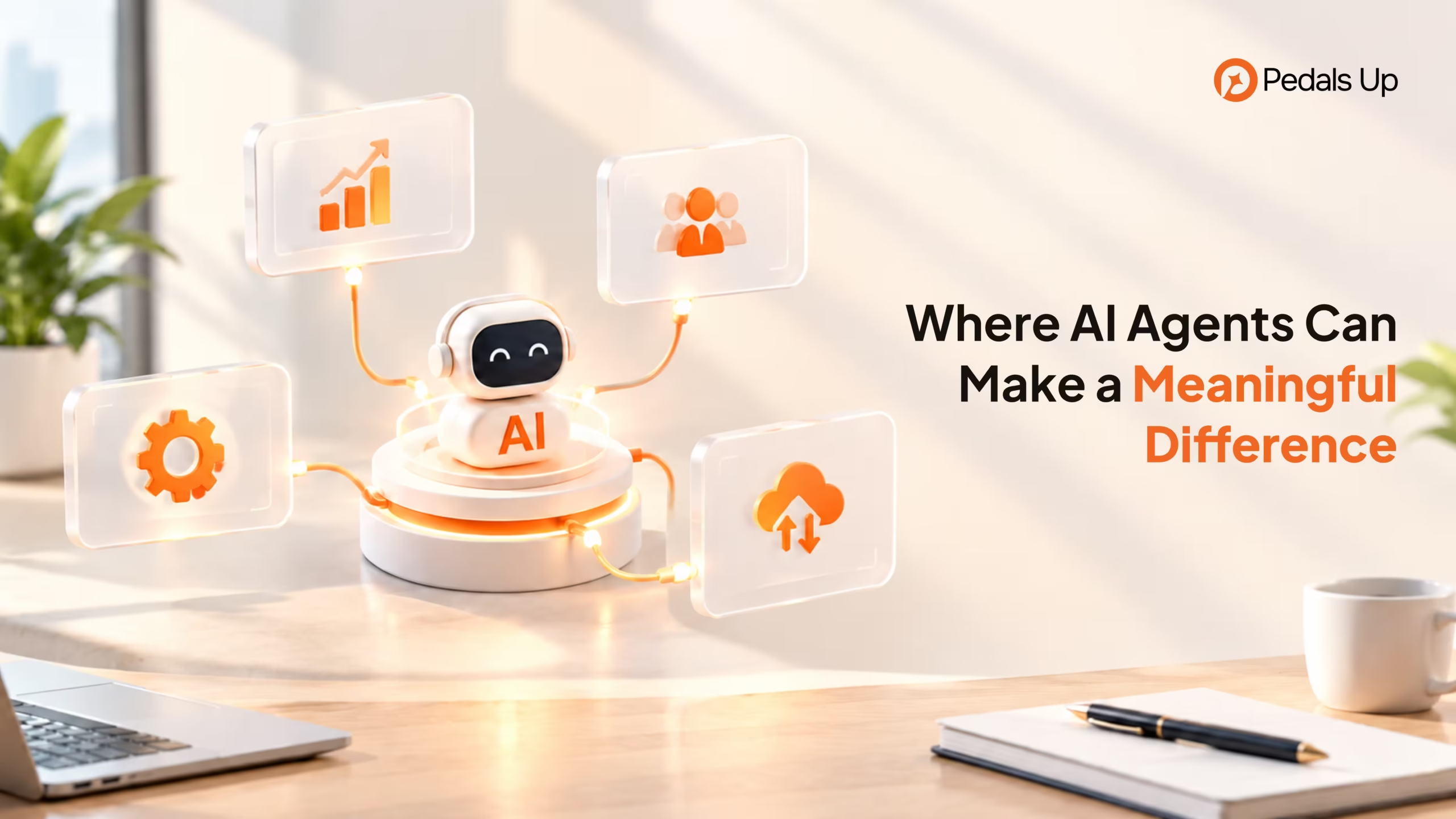
Where AI Agents Can Make a Meaningful Difference
The most promising applications are often found in the gaps between existing software systems. These are places where employees spend time interpreting information, coordinating actions, and resolving exceptions.
Customer Support: From Answering Questions to Resolving Problems
A chatbot can explain a return policy. Resolving a return request may require considerably more work.
The system might need to check the original purchase, confirm delivery status, review the return conditions, and determine whether the customer qualifies for a refund or replacement.
An integrated AI agent could gather that information, identify the appropriate next step, and prepare or initiate an authorized action.
The benefit is not simply faster responses. It is reducing the manual coordination required to resolve an issue.
However, businesses must distinguish between retrieving information and making commitments. Refunds, account modifications, and financial decisions require clearly defined permissions.
Sales: Less Administration, More Time With Prospects
Sales teams regularly move between email, CRM platforms, internal documents, and proposal tools.
A new inquiry may require someone to understand the prospect’s requirements, check existing records, identify missing information, and prepare a response.
AI agents can assist with these activities by interpreting incoming requests, organizing information, and recommending follow-up actions.
This becomes particularly useful when inquiries vary significantly and cannot be processed through fixed forms.
The objective should be to remove administrative delays without giving an agent unrestricted authority over pricing, commitments, or customer communication.
SaaS Products: Helping Users Complete Work
For SaaS businesses, AI agents present an opportunity beyond internal automation.
Consider a project management platform where users manually review updates, identify delayed tasks, and coordinate dependencies. An agent could examine project information and prepare a prioritized list of issues requiring attention.
Similarly, a reporting platform could help users investigate changes across connected datasets instead of manually navigating several dashboards.
These are potential applications, not claims about existing client implementations.
The challenge is that an agent operating inside a SaaS product must respect customer data boundaries, user permissions, and the application’s existing business rules.
Adding intelligence is relatively straightforward compared with ensuring that intelligence behaves correctly within a complex product.
The Workflows You Should Leave Alone
There is a tendency to treat agent autonomy as a sign of technical progress. In practice, giving software more freedom than necessary can make a system harder to control.
A scheduled payment reminder doesn’t need reasoning. Neither does transferring validated information between two applications.
Even some tasks involving language models don’t require agents. If employees simply need answers from company documentation, a knowledge assistant may be sufficient.
The decision becomes more sensitive when incorrect actions have serious consequences.
An agent investigating a suspicious transaction could help collect evidence and prepare findings. Allowing it to independently release blocked payments would introduce a different level of risk.
The distinction is important: an AI agent can contribute to a workflow without controlling every action within it.
Businesses should also consider whether the underlying process is ready for automation. Poor documentation, inconsistent records, and unclear responsibilities do not disappear when an agent is introduced. They become harder to diagnose.
Before investing in custom AI agent development, it is worth asking whether the process itself needs improvement.
How to Decide What Deserves an AI Agent
Instead of identifying every possible automation opportunity, start with one workflow that consumes meaningful employee time or regularly delays an important business outcome.
Examine how the work moves from beginning to end. Where do employees need to interpret information? Which decisions depend on context? What causes the process to stop?
Then assess four practical factors.
Business impact: Will improving this workflow reduce operating effort, shorten resolution times, or improve a measurable customer outcome?
Information readiness: Can the agent access accurate records through existing systems, APIs, or approved documentation?
Decision boundaries: Which actions can happen automatically, which require approval, and which should remain outside the agent’s authority?
Technical feasibility: Can the workflow be integrated and tested without introducing disproportionate development or maintenance costs?
These considerations often reveal that a smaller implementation is the better starting point.
A company considering an agent for its entire support operation might begin with ticket investigation and response preparation. Once the system demonstrates reliable results, additional responsibilities can be introduced selectively.
This approach makes success easier to measure and failures easier to investigate.
Custom AI Agent Development or an Existing Platform?
Not every business needs a custom solution.
Existing agent platforms can be suitable when workflows involve widely supported applications, standard integrations, and relatively straightforward requirements. They can reduce initial development effort and help teams validate an idea.
Custom development becomes more relevant when the agent must work with proprietary software, operate inside an existing SaaS product, follow complex authorization rules, or handle business processes that standard platforms cannot support effectively.
The tradeoff is greater control in exchange for more engineering responsibility.
A custom agent requires more than selecting an AI model. Developers must design how the agent accesses information, chooses actions, handles failed requests, and responds when it cannot complete a task confidently.
Security and observability are equally important. Businesses need to know what an agent accessed, which actions it attempted, and when human intervention was required.
A development partner should therefore evaluate existing tools before recommending custom engineering. Building everything independently rarely makes sense when reliable components already exist.
The Real Investment Begins After the Prototype
A working demonstration can establish technical feasibility, but it cannot establish long-term reliability.
Production agents encounter incomplete information, changing APIs, conflicting instructions, and situations that weren’t included in initial testing.
They also generate ongoing costs through model usage, infrastructure, monitoring, evaluation, and maintenance.
For businesses comparing AI agent development companies, this is an important consideration. The lowest implementation estimate may not represent the lowest total cost of ownership.
An agent that completes a task quickly but regularly requires employee correction may offer little improvement over the original workflow.
Success should therefore be measured through operational outcomes rather than the number of tasks an agent can theoretically perform.
Completion accuracy, handling time, escalation frequency, and cost per successful task provide a more useful picture of performance.
How PedalsUp Approaches AI Agent Development
For PedalsUp, AI agent development fits into a broader product engineering discussion.
The starting point is understanding what the business wants to accomplish, how its existing systems operate, and whether an agent is the right technical solution.
That matters because useful AI agents rarely operate in isolation. They depend on application integrations, reliable data, permissions, and established business processes.
PedalsUp’s software development and AI services provide a foundation for businesses evaluating custom AI capabilities, product integrations, and workflow automation.
The engineering decision should follow the requirements. Some workflows justify custom agents, while others benefit more from improving existing applications or connecting systems through conventional automation.
For companies considering AI agents, the goal should be to build software that fits their operations and remains practical to maintain as requirements change.
Frequently Asked Questions
What are AI agent development services?
AI agent development services involve designing, building, integrating, deploying, and maintaining software agents that use AI models to interpret information, make contextual decisions, and perform authorized tasks across connected systems.
Which business processes are suitable for AI agents?
Workflows involving unstructured information, changing decisions, multiple applications, and repeated investigation are promising candidates. Customer issue resolution, document review, sales qualification, and operational exception handling are common examples.
How much does custom AI agent development cost?
Costs depend on workflow complexity, integration requirements, data availability, security controls, and expected usage. Businesses should account for both initial development and ongoing operational expenses.
Can AI agents integrate with existing software?
Yes. AI agents can connect with CRM platforms, ERP systems, SaaS products, and internal applications through supported APIs and authorized integrations.
The Best AI Agent Is the One You Actually Need
AI agents can change how businesses handle work that previously required employees to interpret information and coordinate actions across multiple systems.
But their value depends on choosing the right responsibilities.
The strongest starting point is not a large autonomous system. It is a clearly defined workflow where contextual reasoning improves an outcome that matters to the business.
Once that value is demonstrated, expanding automation becomes a more informed decision.
Considering AI agents for your business?
PedalsUp can help you assess the opportunity, understand the technical requirements, and determine whether custom AI agent development is the right investment.
Explore PedalsUp’s services and discuss which workflows are worth automating.