Table of contents
Introduction
You just shipped a sprint, and a customer files a ticket: the app crashes on payment, but only for one region and one browser. Your QA team’s triage takes hours. Test suites are running, but they’re built on last month’s API. Junior devs are guessing at the root cause, and leadership is demanding faster cycles.
That’s the essence of QA in 2025: velocity without a trusted, up-to-date context. Large Language Models (LLMs) can describe and suggest solutions, but without accurate facts, they create plausible-sounding responses. RAG (Retrieval-Augmented Generation) corrects this by anchoring the model to your business’s actual, versioned sources. Your LLM ceases to guess and begins to cite. In certain QA pilots, RAG-augmented systems have equaled or surpassed human accuracy and responded in seconds.
This article will demonstrate what does and doesn’t work, and provide a practical guide for how to transition from experiments to production-quality QA workflow systems.
Why Pre-Launch QA Still Fails
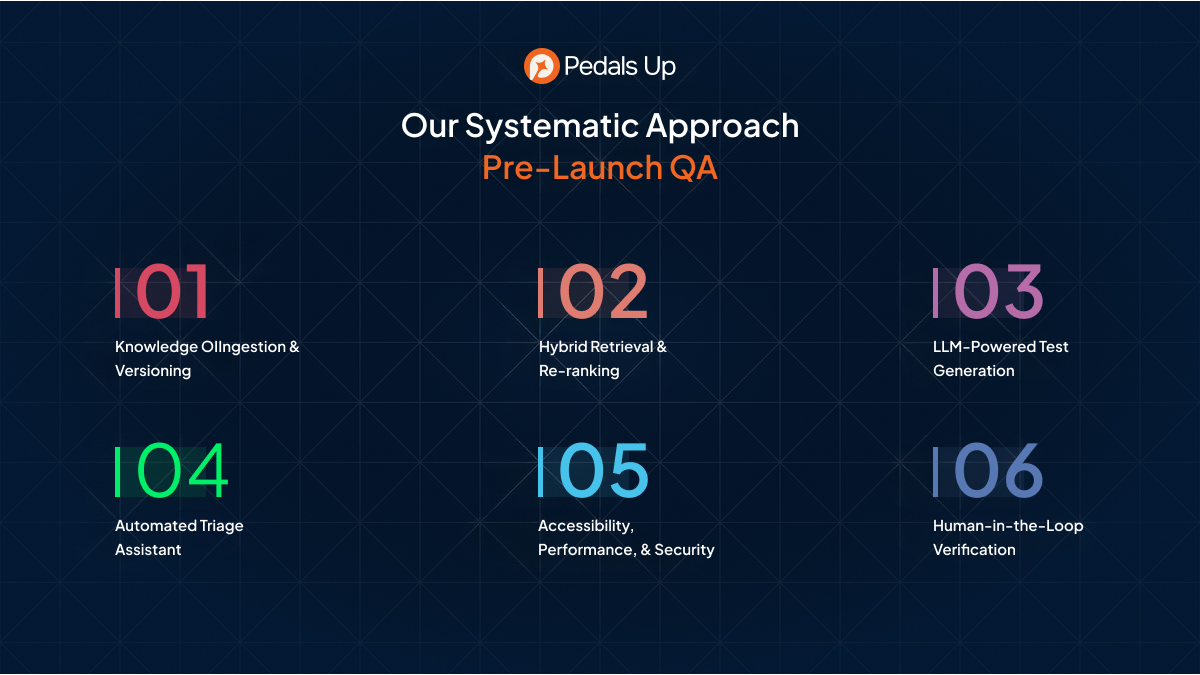
Our Systematic Approach to Pre-Launch QA
We approach pre-launch QA as a discipline, not a one-time test run. Here’s the repeatable, predictable process we execute for clients before every release.
1. Knowledge Ingestion & Versioning
We ingest all your important sources: Jira tickets, design specs, API contracts, runbooks, CI artifacts, and crash logs. We then version everything and tag it so that when the assistant retrieves information, it’s always associated with a particular release.
2. Hybrid Retrieval & Re-ranking
For accuracy, we employ a hybrid retrieval system (BM25 + vector) on the versioned corpus and re-rank the results. Retrieved snippets always contain the source, timestamp, and commit hash.
3. LLM-Powered Test Generation
The LLM creates targeted test cases for the latest changes or high-risk endpoints. It generates regression suites and edge-case scenarios with links to the precise lines of the spec that motivated each test.
4. Automated Triage Assistant
Upon a test or CI run failure, the assistant immediately retrieves historic tickets, similar failure commits, and appropriate logs. It delivers a brief root-cause hypothesis with an assigned owner and a link to a solution.
5. Accessibility, Performance, & Security
We perform programmatic scans for a11y, performance, and security. The assistant breaks down the results into prioritized fixes, creates specific performance tests for key user journeys, and correlates security findings with your runbooks.
6. Human-in-the-Loop Verification
All low-confidence or high-impact items are sent to engineers for verification. All recommendations have provenance, so reviewers can view the precise evidence the assistant relied upon.
A Practical Pre-Launch QA Checklist
This is the checklist that we execute for each of our clients. We automate wherever possible, but have a human-in-the-loop for everything that has an impact on users or compliance.
- Versioned API Spec Check: Did the spec change? We regenerate tests accordingly.
- Contract Tests: We execute consumer-provider checks for all service boundaries.
- Regression Suite Run: We execute smoke and regression tests with emphasis on changed modules.
- Accessibility: We execute automated a 11y scans and manual spot checks.
- Performance: We load test critical user journeys at actual concurrency.
- Security: We execute static analysis, dependency vulnerability scans, and a minimal pen test.
- Error Handling: We test for typical failure modes such as network timeouts.
- Customer Flows: We execute end-to-end tests for primary user journeys such as signup and payment.
- Rollback Plan: We test feature toggles and database migration rollbacks.
- Support Copy: We produce release notes and KB updates with precise source references.
Bug Triage Before and After RAG
Case Study: A Payments Module
One client exporting a payment update had erratic behavior for a single currency. Our pre-launch pipeline:
- Ingested 12 months of tickets, commit messages, payment logs, and API specs.
- The RAG assistant created regression tests for modified endpoints and exposed three previous tickets with the same stack trace.
- Devs resolved a serialization bug before release.
The payoff: the problem never reached production, and an expensive rollback was avoided.
Why Pedals Up?
We don’t give you a model; we give you a full release process that minimizes risk and grows with your product.
- Engineering Discipline: We apply software engineering principles to QA — version control for knowledge, CI for embeddings, and reproducible release gates.
- Practical Ops: Our vector databases, rerankers, and LLMs are released with adequate monitoring and cost controls.
- Integration: We integrate the assistant right into your current workflows (Jira, Slack, CI), not into another siloed tool.
- Governance: We offer role-based access to sensitive data sets and provide complete provenance for compliance.
To have real ROI visibility, we’ll deploy a focused two-week pilot:
- Scope: We’ll target one key flow (payments, signup, or search).
- Deliverables: We’ll provide a staging assistant powered by RAG, a resuscitated test suite for modified endpoints, and a triage dashboard.
- Report: We’ll provide a transparent KPI report of your baseline versus the pilot outcome: triage time, prevented regressions, and saved time per release.
Conclusion
If you’re ready to transform your lead flow into a predictable pipeline, Pedals Up can help you build and scale a pilot program tailored to your unique go-to-market strategy.