Table of contents
Introduction
Time Series Data
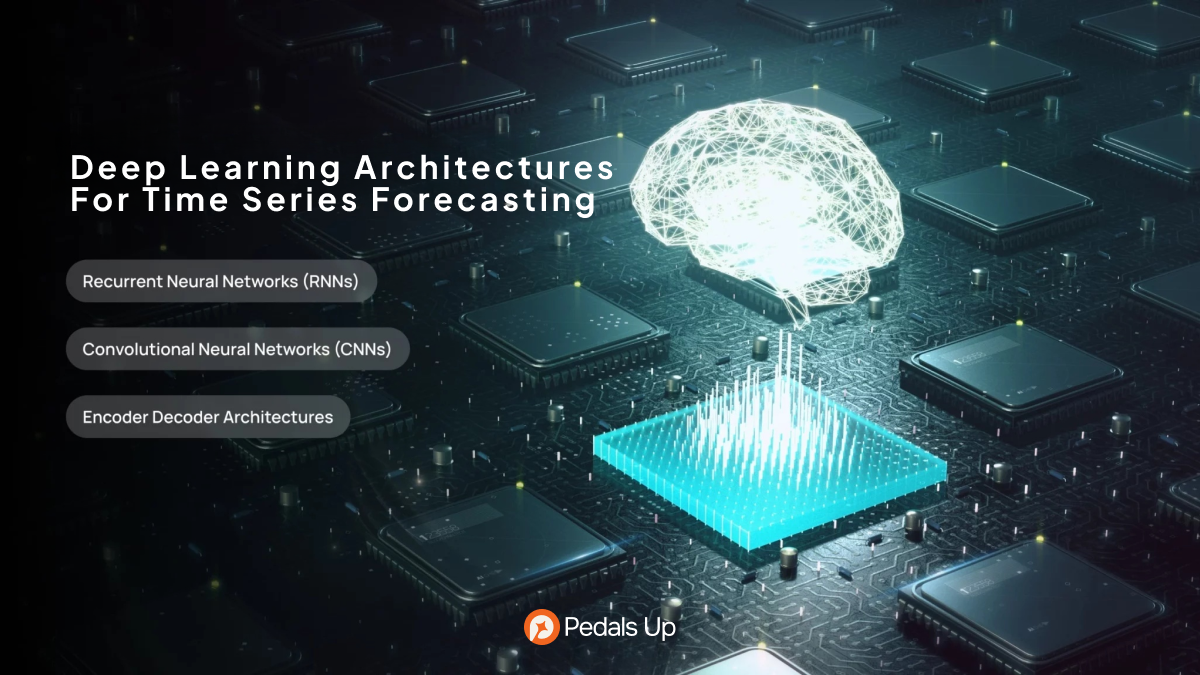
Deep Learning Architectures for Time Series Forecasting
Deep learning architectures are capable of capturing both short-term as well as long-term dependencies within the time series data, meaning they would be particularly suitable for complex forecasting tasks. Let’s look into the most common architectures:
1. Recurrent Neural Networks (RNNs)
RNNs are designed to process sequential data, and hence time series forecasting falls naturally into the domain of RNNs. Unlike traditional neural networks, an RNN is expected to remember past inputs through its internal states. Standard RNN variants are not very effective in handling long-term dependencies due to the vanishing gradient problem. In order to combat this, LSTMs and GRUs were formulated as more advanced variants of RNNs. These models are more successful at learning and remembering longer sequences, which proves to be helpful in the forecasting sceneries where the past affects the results.
2. Convolutional Neural Networks (CNNs)
CNNs are often related with image processing, but this model can easily be applied for time series tasks as well. Although RNNs focus on a temporal relationship, CNNs are better at capturing local patterns in data with the help of convolutional filters. For instance, 1D CNNs can be used to extract features from time series by finding local dependencies. When put together with recurrent layers, this hybrid architecture can resolve such challenges as capturing long-term dependencies alongside local patterns within data leading to precise predictions.
3. Encoder Decoder Architectures
One important application where the encoder-decoder structure really shines in predicting multiple futures at once is the sequence of values into the future. Where the encoder captures the past sequence of the data and distills the pattern to be essential, the decoder generates the future sequence one step at a time. This architecture would really be very useful for tasks where forecasting needs to be done over some extended time horizons-for example, multi-day weather forecasting or longterm predictions of energy consumption.
Applications of Deep Learning for Time Series Forecasting
Deep learning techniques are to be in use across a broad industry basis, thereby improving the significant prediction accuracy for time series forecasting. Some of the key applications are as follows:
- Financial Forecasting: Predication of the price of stock, exchange rate, and market trend will be done properly so that the investment strategy can be created.
- Demand Forecasting: The amount of product in demand can be determined so that the inventory can be managed better and the supply chain optimized.
- Sales Forecasting: Selling trends help manage resources better and pinpoint marketing strategies.
- Traffic Forecasting: Predicting the flow of traffic for managing congestion and optimizing urban planning.
- Energy Forecasting: Predicting energy consumption and demand to improve production and distribution efficiency.
Why Time Series Forecasts using Deep Learning?
Deep learning includes several advantages over traditional methods of forecasting, and so it is very often favored by business over other methods that struggle for high predictive accuracy:
1. Improved Accuracy
Deep learning models discover typically ignored, nonlinear patterns in the data while traditional models are not able to do so. Because of learning complex relationships between variables, deep learning models perform better than statistical methods and do it with a growing margin.
2. Flexibility
Deep learning models are easily adaptable to a wide range of forecasting tasks. No matter how it would be either one step ahead or more time steps ahead of the present time, architectures could be adapted to particular demands in forecasting practices.
3. Scalability
Unlike the conventional models, which become unwanted in the presence of vast datasets, deep learning models scale perfectly and can be directly applied to any real-world application with copious amounts of historical data.
Problems with Deep Learning for Time Series Forecasting
Although deep learning models have been found to have numerous advantages, there are certain problems that they present to businesses and should thus be watched out for.
- Data Requirements: The data required by the deep learning models is huge, high in quality, and should abound. An especially scanty amount of data will negatively affect a model’s performance.
- Computational Cost: Deep learning models are expensive to train; their training may require specialized hardware like GPUs to speed up training times.
- Interpretability: It is often referred to as a “black box” because its inner workings cannot be interpreted. This is an advantage in industries that require the understanding of decisions generated by a model.