
Table of contents
Introduction
What if every diploma, transcript, and micro-cert you offered could be confirmed instantly and unimpeachably? Employers, universities, and learners continue to waste too much energy and time pursuing trust. Studies and pilots demonstrate that blockchain can substantially minimize that friction, but extensive, large-scale usage is still in its infancy. (Source: World Economic Forum)
The Core Problems Education and Industry Confront
Before the solution, let’s look at the pain. The current system is plagued by friction, cost, and risk:
- Fragmented Systems: Disjointed systems among employers and institutions create sluggish, error-ridden transfers of records.
- Widespread Credential Fraud: Résumé misrepresentation and credential fraud are prevalent, leading to high verification expenses and the risk of bad hires. Recent surveys reveal substantial percentages of applicants acknowledge exaggerating or lying on application forms.
- Administrative Overhead: Staff time is eaten up by manual administrative tasks like processing transcripts, scholarships, and refunds.
- Lack of Lifelong Records: The unavailability of secure lifelong learning records makes it difficult to integrate a learner’s informal and formal education.
- Slow Verification: There is an industry need for quick proof; delayed verification slows down hiring and career mobility.
These problems are widely established in scholarly reviews and industry reports.
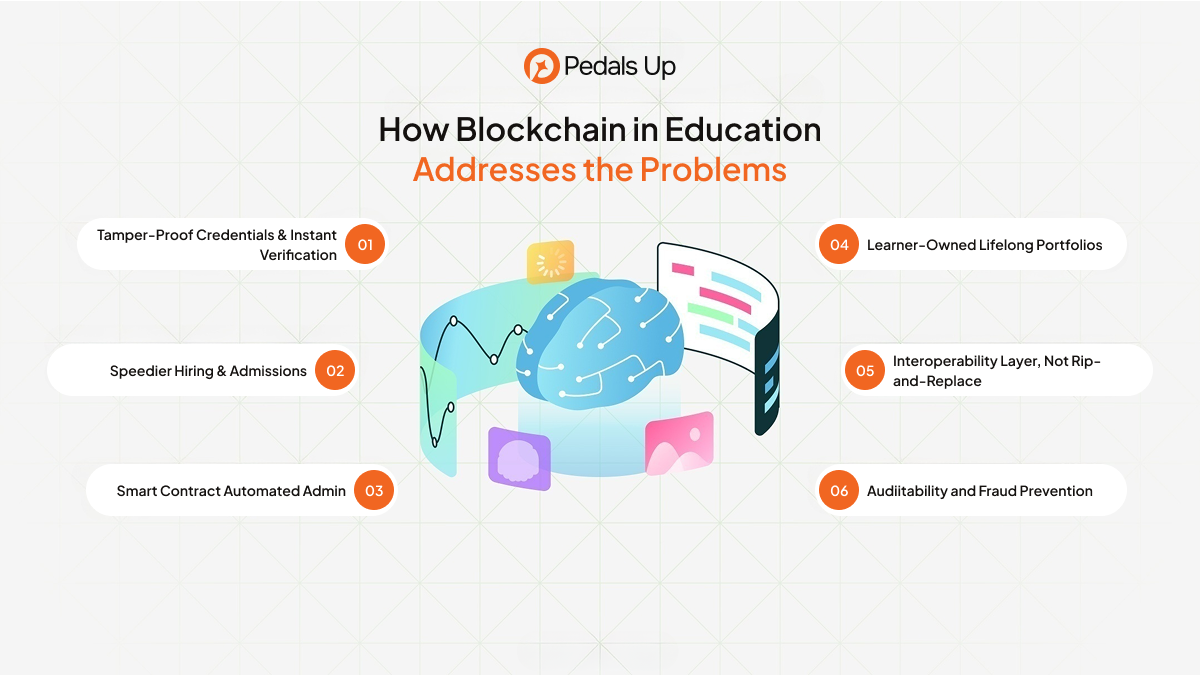
How Blockchain in Education Addresses These Problems
Blockchain is no silver bullet, but its inherent characteristics align neatly with the issues listed above: immutability for trust, cryptography for verification, smart contracts for automation, and decentralization for learner control.
- Tamper-Proof Credentials and Instant Verification: When a credential’s integrity is anchored to a blockchain, tampering becomes impossible. Authenticity can be instantly verified without manual back-and-forth.
- Speedier Hiring and Admissions: Rather than phoning registrars, employers and schools are able to check against a verifiable record, enabling them to make decisions more quickly and lowering geographic friction.
- Smart Contract Automated Admin: Payments, scholarships, refunds, and conditional disbursements can be turned into smart contracts. Actions are triggered automatically once conditions are fulfilled, eliminating manual checks and delays.
- Learner-Owned Lifelong Portfolios: Blockchain enables learners to maintain one verifiable portfolio of all degrees and micro-credentials, which they can selectively share with employers or schools.
- Interoperability Layer, Not Rip-and-Replace: Blockchain works best as a common fabric that current Learning Management Systems (LMS), Student Information Systems (SIS), and certification bodies can plug into through APIs.
- Auditability and Fraud Prevention: A tamper-evident ledger simplifies audits and significantly increases the barrier to fraud. Systematic reviews cite lower verification overhead as a key benefit.
Real-World Pilots and Examples
Evidence of this technology is already visible through numerous initiatives:
- YourOneLife (India): An AICTE-affiliated initiative utilizing blockchain for student engagement and credentialing. Vendor claims suggest the potential to serve millions of students.
- Trusted Achievement-Record Prototypes: Academic groups have successfully created and tested prototype systems that produce verifiable accomplishment records, providing valuable technical precedents.
- Policy and Challenge Programs: The US Department of Education / ACE hosted a Blockchain Innovation Challenge to find interoperable, learner-focused solutions, a clear sign of institutional funding and interest in pilots.
- Systematic Reviews: Multiple peer-reviewed articles confirm the landscape: many pilots exist, certificate issuance is the most common use case, and broader system integration is a research priority.
Honest Risks and Practical Mitigations
Realistic Roadmap for Institutions
Institutions should frame blockchain adoption as a staged program: pilot, prove, integrate, govern.
- Discovery & Feasibility: Map existing systems and select a single high-potential use case (e.g., digital diplomas or scholarship automation).
- Pilot / MVP (Minimum Viable Product): Develop a permissioned pilot for that single use case; issue a small batch of verifiable credentials.
- Integration: Connect to existing LMS/SIS, develop necessary APIs, and test actual verification flows with employers.
- Governance: Establish node operators and write clear governance rules (consortium or permissioned model) for the network.
- Scale & Optimize: Expand the scope to additional use cases, monitor costs and performance, and iterate on the solution.
For institutions that want a partner, Pedals Up can execute the discovery, develop the MVP, integrate with your SIS/LMS, and consult on governance and compliance. Learn more about our services: https://pedalsup.com/our-services