Table of contents
Deep Tech Software Development: From Innovation to a Working Product
A breakthrough algorithm can work in a laboratory and still fail commercially. The algorithm is rarely the only problem. Real users need dependable workflows, integrations, understandable outputs, and a system that behaves predictably outside controlled conditions.
That is what makes deep tech software development different. Teams must make advanced technology operable and trustworthy. Founders must resolve critical uncertainties before a full build.
What Is Deep Tech Software Development?
Deep tech software development builds products around significant technical innovation. It can involve artificial intelligence, advanced analytics, robotics, cybersecurity, simulation, blockchain infrastructure, or software connected to specialized hardware.
Many use conventional cloud services, APIs, databases, and interfaces. What changes is the underlying uncertainty: a model may behave differently on new data, a sensor may deliver inconsistent signals, or a computation may become too expensive at production volume.
Unlike a conventional business application, where the core workflow is often understood before development begins, a deep tech product may still need to prove that its defining capability works reliably under practical constraints.
Why Conventional Development Plans Often Fall Short
Traditional software delivery typically assumes that requirements can be translated into features, estimated, developed, and tested. Deep tech teams need that discipline too, but feature completion cannot be the only measure of progress.
Consider a hypothetical industrial monitoring platform that uses machine learning to detect equipment anomalies. Its dashboard might be finished on schedule while the model produces too many false alarms. Operators eventually stop trusting its alerts.
A stronger plan separates three questions: Does the technology work? Can it work inside the customer’s environment? Will someone rely on it enough to change their workflow?
Each question requires different evidence. Treating all three as one development milestone hides risk until late in the project.
Validate the Hardest Assumption Before Building the Platform
First, test the assumption most likely to invalidate the business. That may be model accuracy, device connectivity, processing latency, data availability, or the ability to explain a technical result.
Confusing technical feasibility with product validation can leave a polished application resting on an unproven foundation.
For an AI inspection product, a sensible first experiment might use representative images from real operating conditions rather than a full web application. The team would measure detection performance across lighting, equipment variations, and unusual cases. Only after the evidence is credible should it invest heavily in dashboards and customer administration.
Define success thresholds, test data, limitations, and a decision point.
Architecture Must Account for Scientific and Operational Uncertainty
Deep tech architecture should isolate components likely to change as research develops. That usually means separating core algorithms or models from application workflows, data ingestion, user interfaces, and external integrations.
A research team may replace a model while the product team continues improving onboarding. A hardware vendor may change a device interface without forcing a redesign of reporting. An enterprise customer may require a different deployment environment without altering the underlying analysis.
Clear contracts between components, versioned APIs, reproducible processing, and documented data formats reduce the cost of those changes. Teams also need to decide early where computation belongs: on a device, at the edge, or in the cloud.
Cloud processing offers flexibility and centralized maintenance, but it introduces network dependencies and ongoing infrastructure costs. Edge processing can improve latency and support disconnected environments, yet makes updates, device management, and observability harder. Design for actual operating conditions.
Recent engineering analysis of hardware and software co-design highlights another difficulty: teams often work with different tools and development cycles, making integration a coordination problem as much as a technical one.
Reliability Is a Product Feature, Not a Final Test
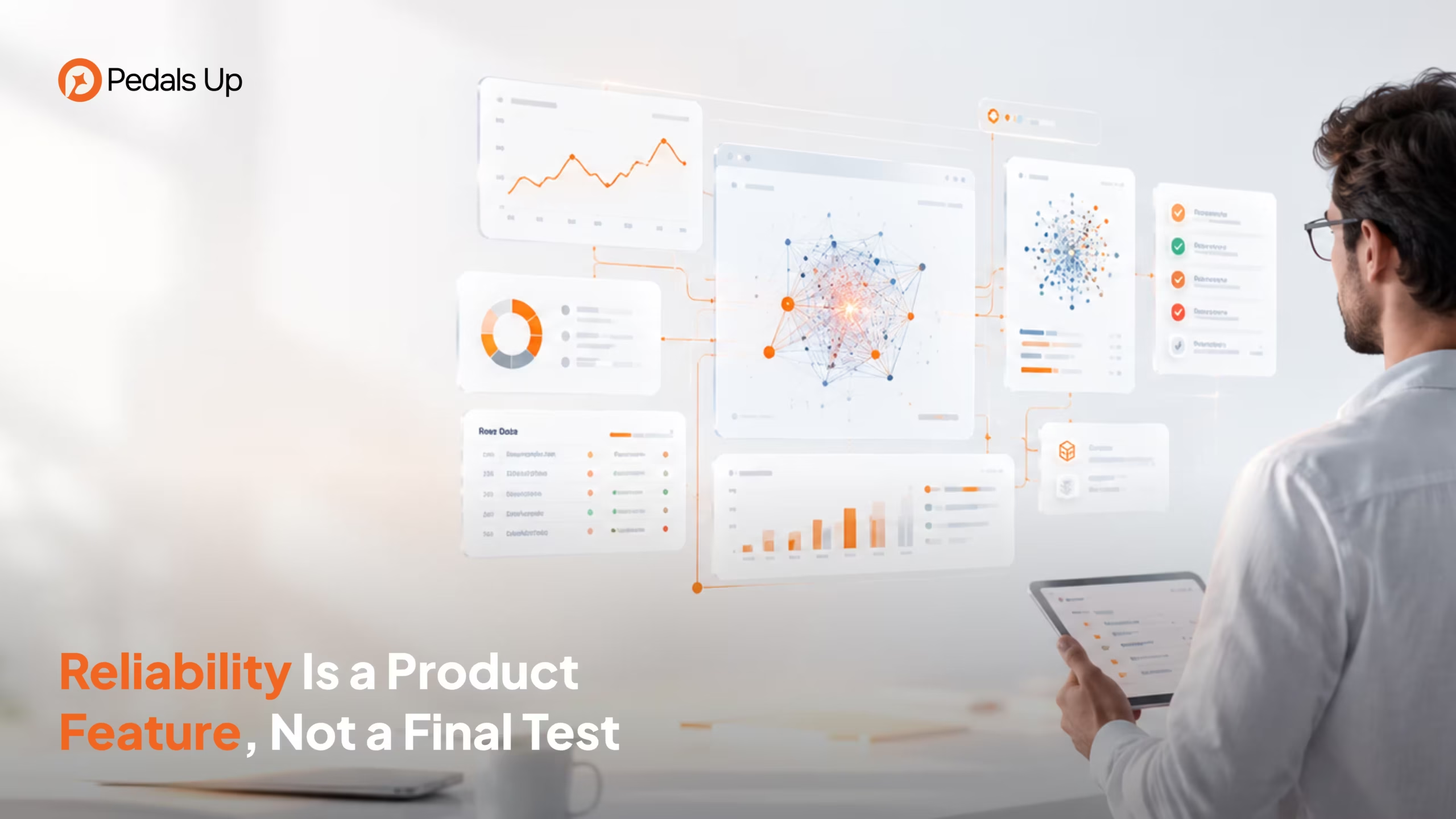
For technically complex systems, reliability must be defined in terms users understand. An AI model’s accuracy score does not tell an operator how frequently they will receive a false alarm. A fast simulation means little if its assumptions are hidden. A security platform that detects issues but cannot explain their priority may create more review work than it removes.
Engineering teams should translate technical metrics into operational consequences. Depending on the product, that might mean false positives per shift, time to investigate an alert, acceptable downtime, recovery time, or the cost of processing one transaction.
The NIST AI Risk Management Framework offers a useful reference for AI systems, emphasizing validity, reliability, safety, security, transparency, and ongoing risk management. It does not replace product-specific testing, but it reinforces the need to assess systems throughout their lifecycle rather than at launch alone.
Practical safeguards include monitoring for data drift, tracking model versions, retaining audit records, testing degraded network conditions, and designing human review paths for consequential decisions.
The Hidden Cost Is Often Outside the Core Technology
Deep tech budgets frequently concentrate on the novel component: training a model, building an analytics engine, or integrating a specialized device. Yet commercialization introduces work that is less exciting and just as necessary.
Data pipelines need maintenance. Enterprise buyers may demand identity management, access controls, audit trails, and deployment documentation. Support teams need tools to diagnose failures. Customers need onboarding that explains what the system can and cannot do.
A technically successful prototype may also carry costs that rise with usage. GPU inference, high-frequency sensor ingestion, retained telemetry, and intensive simulations can make unit economics unattractive long before the product reaches a large customer base.
This suggests a useful rule: estimate the cost of delivering one successful customer outcome, not merely the cost of running one computation. Include infrastructure, manual review, failed attempts, support, and integration maintenance. A cheaper algorithm is not necessarily a cheaper product if it demands more human intervention.
Product Design Determines Whether Innovation Gets Adopted
Deep tech users rarely buy complexity for its own sake. They buy a better decision, a faster investigation, a more accurate prediction, or a capability they could not access before.
That creates a demanding design problem. Simplifying an interface must not conceal uncertainty that matters. A risk score, for example, may need supporting evidence, confidence information, and a clear route to investigate the underlying findings. Showing a single number without context can make an advanced system appear simpler while making it less trustworthy.
Designing these workflows together helps prevent the common mistake of building a technically sophisticated tool that only its creators can operate.
PedalsUp’s deep tech product development focus addresses this gap between advanced capabilities and usable software, particularly across AI platforms, analytics, security tooling, and complex digital infrastructure.
Choosing the Right Development Partner
A deep tech software development partner should be evaluated on how they handle uncertainty, not simply how many frameworks they know. The most useful early conversation is about what could prevent the product from working in production.
Ask how the team will validate technical assumptions, divide responsibility between domain specialists and software engineers, and measure reliability. Review its approach to data ownership, integration testing, architecture decisions, and post-launch support. Where specialized scientific or hardware expertise is required, establish who provides it rather than assuming a general software team covers every discipline.
Engagement should match technical maturity. Early research may benefit from a small team and short experiments. Once feasibility is demonstrated, product engineering, design, quality assurance, and infrastructure work can expand around a clearer specification.
From Prototype to Commercial Product
Production requires evidence, not just a launch event. Technical feasibility comes first, followed by integration under realistic conditions, supervised user validation, and controlled expansion.
Each stage should produce an artifact the next stage can rely on: benchmark results, interface specifications, test reports, operating procedures, or documented customer feedback.
Teams should resist measuring progress only through releases or feature counts. Better indicators include reduced uncertainty, stable operating performance, lower cost per outcome, and repeatable deployment. Those measures show whether the business is becoming easier to scale rather than merely more complicated to maintain.
Build for the Reality Beyond the Demo
Deep tech software development succeeds when scientific or technical advantage survives contact with real operating conditions. The best architecture is not necessarily the most elaborate, and the best roadmap is not the one with the most features. Both should help the team test important assumptions early, manage risk, and make the technology useful to its intended users.
PedalsUp works with teams turning complex technical ideas into practical digital products. Explore our software development services or discuss an architecture review to identify what needs proving, building, or simplifying before your next major investment.