

Table of contents
Introduction
You can create a prototype in a day using Vibe coding. You can also lose millions of dollars because one line of code was never questioned. Vibe coding delivers speed and convenience. Hard engineering delivers predictability and accountability. They are not the same thing, and confusing them is a huge risk.
This blog discusses why treating vibe coding as a software development methodology is dangerous, what measurable costs look like, and how teams should balance AI tools with strict engineering practices to achieve speed without disaster.
What People Mean by Vibe Coding
The Hard Numbers: Technical Debt is a Debt Machine
Real-World Failure: Knight Capital
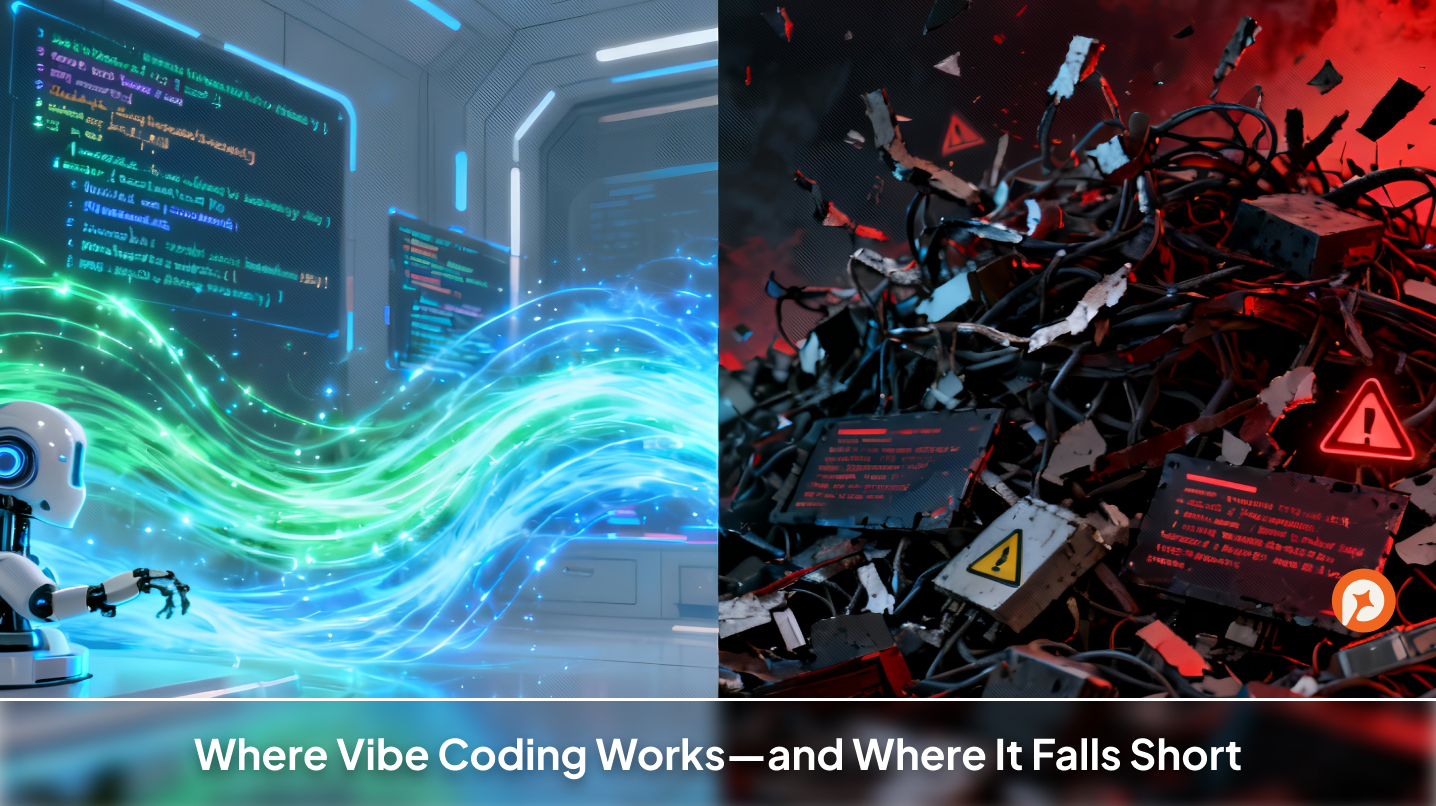
Where Vibe Coding Works, and Where It Falls Short
Vibe coding has its place. It’s terrific for:
- Quick prototypes and proof-of-concept concepts.
- Creation of boilerplate, examples, and ideas for skilled engineers.
- Facilitating non-developers to test ideas with a speed check.
Vibe coding is broken when employed as a replacement for an engineering practice:
- Business logic for production is coded with no human authorship or in-depth examination.
- Security-sensitive or regulatory compliance code where auditability is important.
- Systems needing long-term maintainability, transparent ownership, or deterministic performance.
The line is straightforward: Leverage AI to aid engineering. Do not use AI as a sightless author.
Four Explicit Failure Modes
- Invisible Assumptions: AI-generated code will depend on library behavior, defaults, or edge-case semantics the prompter never had in mind. Those assumptions become fatal bugs down the road.
- Fragile, Untested Glue: AI will glue together code that too frequently has incomplete test coverage and boundary tests. Incomplete tests cause bugs to live in production.
- Unclear Ownership: When no developer documents a key code path, on-call rotations become triage hunts. No one knows who can squash what soon.
- Hidden Technical Debt: Rapid AI fixes can create tightly coupled modules and hacky solutions that impede subsequent changes. The debt accrues, burying future velocity.
A Practical Case Study in Discipline
From Vibe to Vetted: A Practical Checklist for Responsible AI Use
1. Ownership & Review Gates
- Human Ownership: Always have a human owner for every change brought to the codebase.
- Mandatory Review: Mandate a standard two-party code review process, sign-off, regardless of how the change was written.
- Transparent Audit Trail: Version control generated code and prompt artifacts with good commit messages and track who approved the change.
2. Testing Gates
- Mandatory Unit Tests: Unit tests should always be included with any change that impacts business logic.
- Coverage for Critical Flows: Include integration and end-to-end tests for critical business or payment flows.
- Change Management: Have change-based or feature-flagged rollouts and specify explicit rollback plans.
3. Security & Operations
- Static Analysis: Do static analysis and dependency checks on every new code, including AI-written pieces.
- Operational Safeguards: Apply circuit breakers, safe defaults, and kill switches in production environments.
- Budget for Refactoring: Make architecture decisions explicit and documented. Budget time for refactoring, technical debt costs real money.
Final Thoughts
We approach AI as a complement, not a substitute. We construct production-ready systems with automated testing, explicit ownership, and phased rollouts. If you are prototyping using vibe coding, we can assist you in hardening the prototypes into stable products with the appropriate balance of speed and safety. Find out more about our bespoke software development services.