Table of contents
Real Estate Software Development: What Should You Build, Buy, or Integrate?
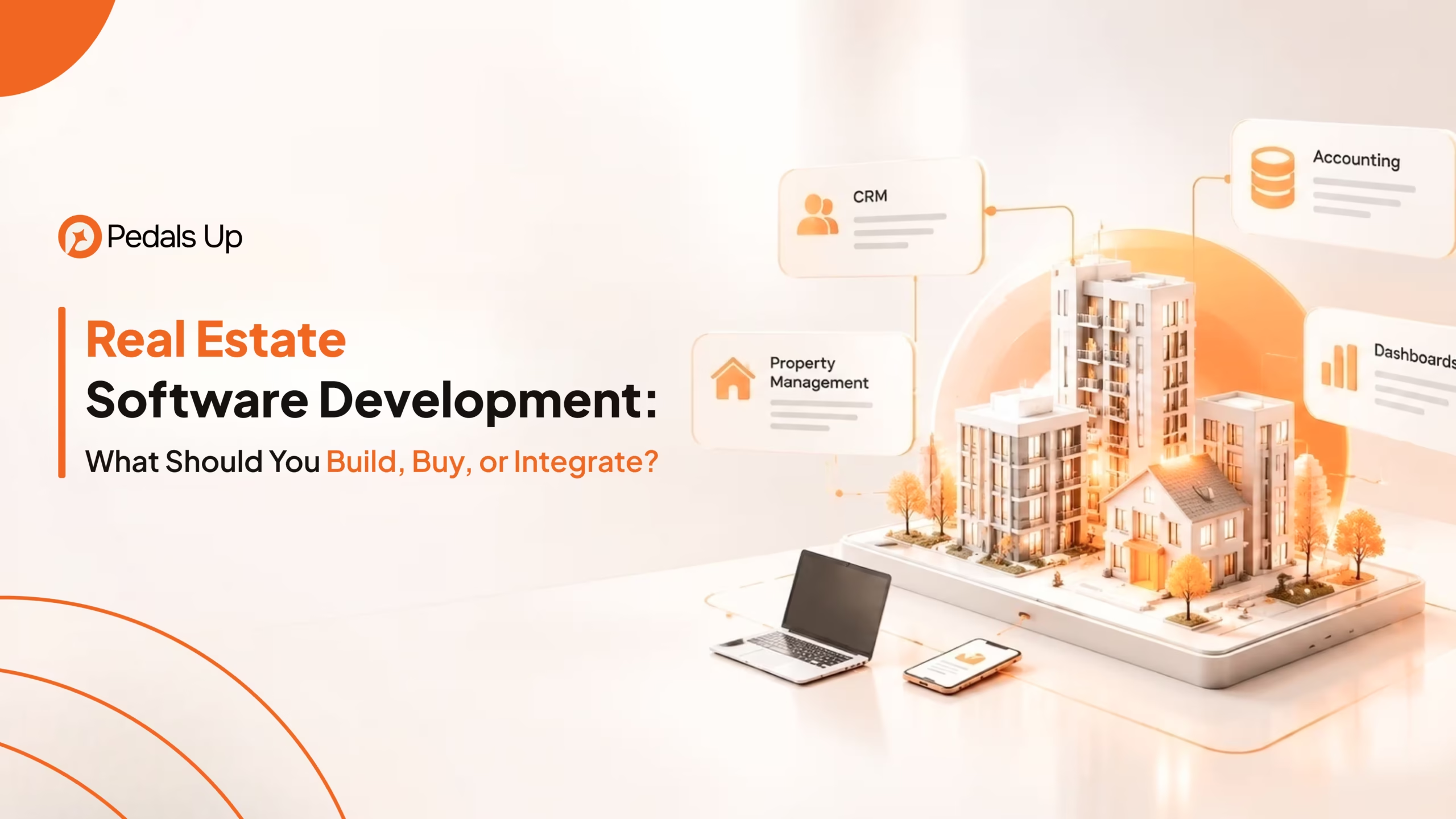
A real estate company can have a CRM, property management platform, accounting system, and several dashboards yet still struggle to answer a basic question: which units are available right now? The problem is rarely a complete absence of technology. More often, different systems hold different versions of the same information.
That is why real estate software development should begin with a business architecture decision, not a feature list. Some capabilities are sensible to buy, others justify custom engineering, and many problems are best solved by connecting the software already in place.
For developers, brokerages, property managers, and PropTech founders, choosing the wrong approach creates more than an unnecessary development bill. It can lock critical data inside vendors, multiply manual reconciliation, and make future automation harder.
What Does Real Estate Software Development Actually Cover?
Real estate software development involves designing, building, extending, and integrating applications that support property sales, leasing, management, investment, and operations. The scope might be a customer portal, an internal workflow tool, a marketplace, or a platform serving thousands of users.
A brokerage may need lead distribution and commission tracking. A developer managing multiple projects may need unit inventory, booking approvals, payment milestones, and channel partner access. A commercial property operator may prioritize lease obligations, maintenance, tenant communication, and portfolio reporting.
These are different businesses with different sources of operational complexity. Treating them as variations of one generic property application is an expensive mistake.
When Buying Existing Software Is the Better Decision
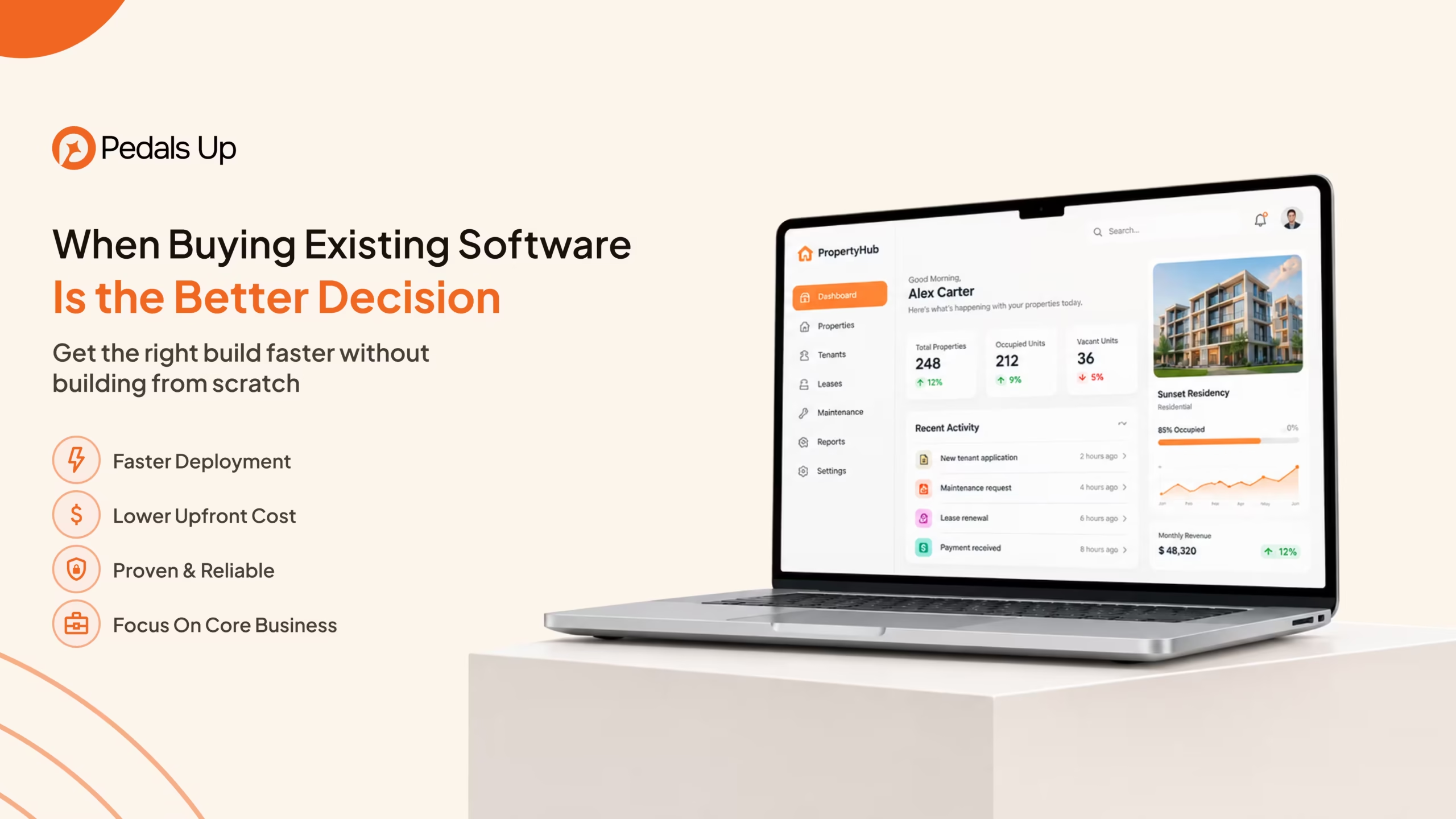
Buying makes sense when the workflow is established, the product covers most requirements, and speed matters more than differentiation. Accounting, electronic signatures, basic CRM functions, and routine property administration often fall into this category.
Established vendors such as Yardi and AppFolio offer property management capabilities that would require substantial engineering and ongoing maintenance to recreate. Before building, ask what the business would gain that configuration or integration cannot provide.
Evaluate more than subscription pricing. Review export rights, API availability, permission controls, regional suitability, implementation support, and what happens when the number of properties or users grows. A low starting fee can become less attractive if essential functions require expensive add-ons or manual work.
When Custom Real Estate Software Is Worth Building
Custom development becomes defensible when a workflow is central to how the business competes and cannot be supported adequately by existing products. The test is not whether employees dislike their current interface. It is whether the limitation creates a measurable commercial or operational cost.
Consider a developer selling inventory across several projects, sales teams, and channel partners. If reservation rules, unit availability, approvals, and payment schedules vary by project, generic CRM customization may eventually become difficult to govern. A purpose-built inventory and booking service could provide consistent rules across channels while leaving the CRM responsible for customer relationships.
Custom does not automatically mean better. The business inherits testing, security, uptime, documentation, and long-term maintenance obligations. A narrowly scoped product with clear ownership usually has a stronger case than an ambitious replacement of every existing tool.
Why Integration Is Often the Missing Third Option
Build versus buy presents a false choice when the real issue is information moving between systems. A company might have an effective CRM and accounting platform, but staff still copy booking details into spreadsheets before finance can issue payment schedules.
An integration layer can synchronize records, apply business rules, and expose a reliable operational view without replacing either platform. The critical decision is which system owns each piece of information.
For example, the inventory service might be authoritative for unit availability, the CRM for lead ownership, and accounting for posted financial transactions. A reporting dashboard can combine those records, but it should not silently become another place where employees edit them.
The hidden risk: a successful sync can still produce the wrong result
Imagine a booking event is delivered twice after a network timeout. If the receiving system creates two reservations, the integration has technically processed both messages while producing an unacceptable business outcome.
Reliable integrations therefore need stable identifiers, duplicate handling, reconciliation processes, and alerts for failed updates. Microsoft’s documented idempotent consumer pattern explains how repeated message delivery can be handled without repeating the underlying business action.
Five Questions to Decide What to Build, Buy, or Integrate
Before approving a software budget, leadership should answer five questions together with operations and engineering.
Where does the workflow create competitive advantage? Standard processes are usually candidates for purchased software. Proprietary pricing, booking logic, investment analysis, or customer experiences may justify development.
Which system is the source of truth? Identify who can create or change each important record. If two applications can independently change unit status, an attractive dashboard will not solve the underlying conflict.
Can existing vendors support the required integrations? Check actual API documentation, rate limits, webhooks, export formats, and contract restrictions. An advertised integration is not proof that every field or event you need is available.
What happens when a transaction fails halfway through? Define how staff discovers, retries, reverses, or reconciles incomplete bookings and payments. Exception handling belongs in the original scope, not a later maintenance ticket.
Who will own the software after launch? Budget for monitoring, security updates, vendor changes, support, and product decisions. Even a small custom component needs a responsible owner.
What Actually Drives Real Estate Software Development Costs?
Feature count is only part of the budget. Two applications with similar screens can have very different costs because one operates independently while the other must coordinate live inventory, finance, and external partners.
Integration complexity is a major driver. Each external provider introduces authentication, data mapping, error handling, changing APIs, and testing requirements. Migrating historical records adds another layer, particularly when addresses, units, customers, and contracts have inconsistent identifiers.
The ongoing cost includes cloud infrastructure, observability, security reviews, support, and adapting to changing vendor APIs. A credible estimate should separate initial delivery from annual ownership rather than disguising both inside one launch price.
Instead of requesting a quotation for an entire platform immediately, commission a short discovery exercise. Map the workflows, inspect integrations, identify high-risk dependencies, and estimate a first release that can prove operational value.
Building for AI Without Making AI the Starting Point
AI can help classify inquiries, summarize tenant messages, retrieve property information, and assist staff with document review. But it cannot compensate for contradictory inventory records or unclear access permissions.
A useful AI assistant needs dependable access to approved information and a clear boundary between suggesting an action and executing it. For instance, an assistant might recommend available units based on verified inventory, while a booking service performs the reservation after required checks.
This distinction matters because generated text can be uncertain, whereas booking availability and financial obligations must follow deterministic rules. Keep transactional authority inside tested business services and require human approval for consequential exceptions.
JLL’s 2026 guide to real estate AI decisions frames buying, enhancing, and building as competing investment options. The practical lesson is to establish data readiness and operational ownership before funding a large AI initiative.
A Practical First Release for a Real Estate Business
Suppose a developer manages several residential projects and receives leads from its website, sales agents, and external property channels. Its immediate complaint is slow reporting, but investigation reveals that unit status changes are updated separately in three places.
This is a hypothetical example, not a PedalsUp client case study. The sensible first release may be a centralized inventory service with controlled updates, CRM synchronization, and a simple exception dashboard. Rebuilding accounting or designing a new consumer app would add cost without addressing the central failure.
Success could be measured through fewer conflicting unit records, less manual reconciliation time, faster confirmation of availability, and the number of integration failures resolved within an agreed period. Establish baseline measurements before implementation so improvement can be demonstrated rather than assumed.
Once the inventory foundation is reliable, the business can consider channel partner portals, automated customer updates, or AI-assisted recommendations.
Choose the Architecture Before the Feature List
The most valuable real estate software is not necessarily the most customized. It is the system that preserves accurate information, supports the workflows that matter, and remains adaptable as the business grows.
Buy mature capabilities when they meet the need. Build where proprietary processes or product differentiation justify ownership. Integrate when disconnected systems are the real source of friction. Most importantly, decide where records, rules, and responsibilities belong before commissioning another interface.
PedalsUp works across product engineering and software development services for businesses evaluating these choices. If your real estate operation is planning a new platform or struggling with disconnected systems, start with an architecture review that identifies what to keep, what to connect, and what is genuinely worth building.