Table of contents
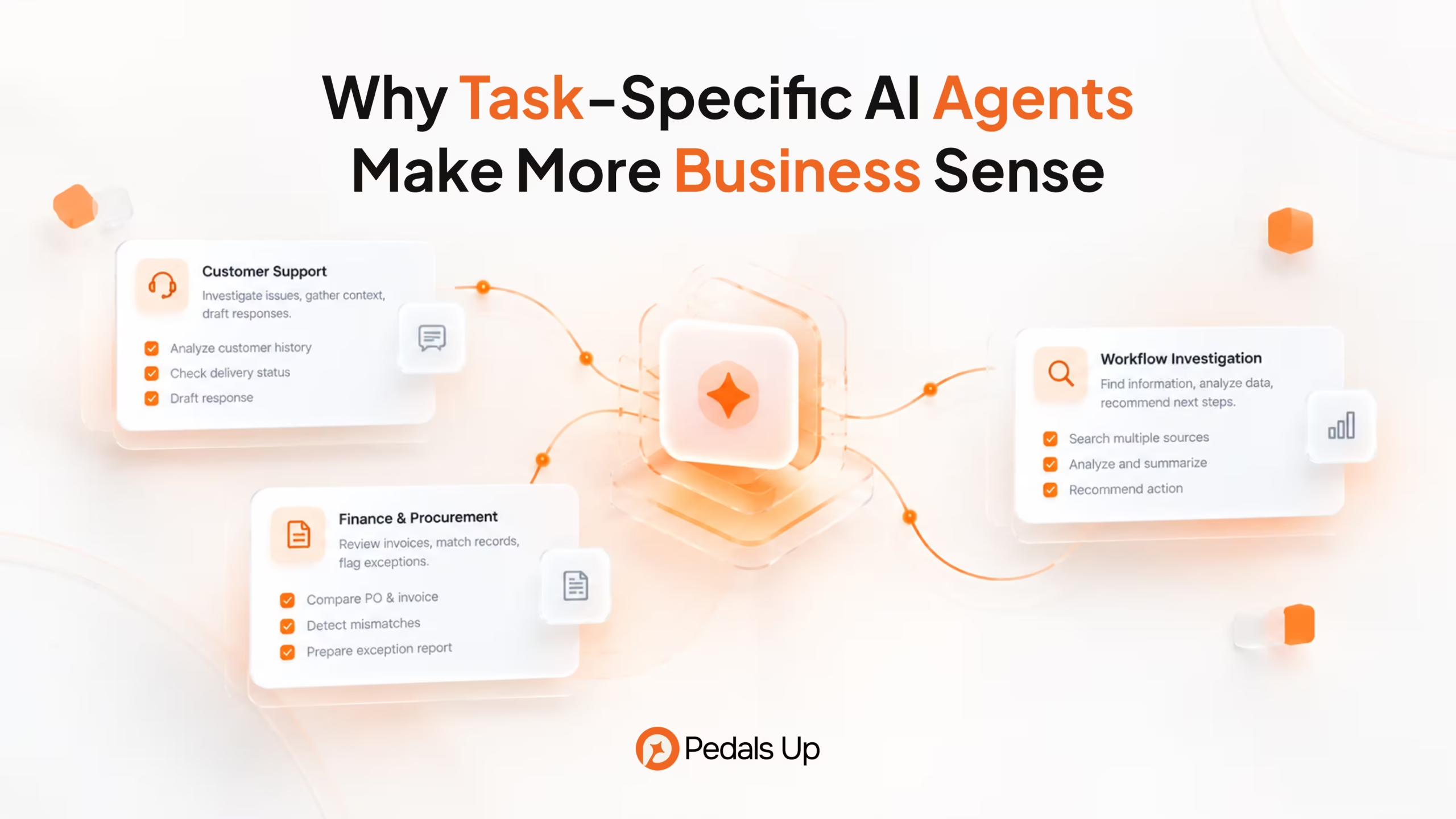
Why Task-Specific AI Agents Make More Business Sense
An AI agent that can handle fifty different requests sounds impressive. An agent that reliably resolves one expensive operational bottleneck may be far more valuable. That distinction is why task-specific AI agents deserve attention from businesses planning their next AI investment.
The challenge is rarely a shortage of possible applications. It is deciding how much responsibility to give software that can interpret information, select tools, and act on behalf of employees. A narrow assignment makes those decisions easier to evaluate. It also makes failure easier to detect before it reaches a customer, financial record, or production system.
What Are Task-Specific AI Agents?
Task-specific AI agents are systems built to complete a defined category of work using AI reasoning, relevant information, and authorized tools. Their responsibilities are deliberately bounded. An agent might investigate delivery complaints, review procurement exceptions,s or prepare evidence for a compliance analyst. It does not need permission to perform unrelated business activities.
There is an important distinction between an agent and ordinary automation. A fixed script follows predetermined steps. An AI workflow may use a model to classify or summarize information while software controls the sequence. An agent can choose which permitted tool to use next based on the situation it encounters.
Anthropic’s guidance on building effective agents distinguishes predefined workflows from systems where models direct tool usage. It also recommends adding complexity only when simpler approaches cannot meet the requirement. That is a useful starting principle for any engineering team.
Anthropic
Why Specialization Changes the Business Case
The argument for focused agents is not that smaller systems are automatically more accurate. It is that their performance can be measured against a clearer definition of success.
Consider a hypothetical accounts payable team. An agent receives an invoice, retrieves the corresponding purchase order, compares quantities, and flags mismatches. Its job ends when it produces a verified match or an exception requiring review. That scope is easier to test than a general finance assistant expected to manage payments, forecasts, and supplier communication.
Better Control Over Decisions
An agent’s instructions describe acceptable behavior, but instructions alone are not an access-control system. Actual permissions must be enforced through the application and its connected tools.
An invoice agent may read approved purchase orders and prepare a reconciliation report without being able to release funds. If it produces a wrong recommendation, an approval step can prevent the error from becoming a transaction. The business can expand authority later, based on observed performance rather than confidence in a demonstration.
Where Task-Specific Agents Are Useful
The best candidates involve repeated work that requires contextual judgment, access to several information sources, and a result someone can verify. Two examples illustrate the differences.
Customer Support Investigation
A support agent can interpret a complaint, retrieve order history, inspect delivery events, and draft a response grounded in company policy. Routine tracking questions may need nothing more than an existing API integration. The agent earns its place when it must reconcile inconsistent information or determine which escalation route applies.
Initially, it might only recommend a response. Account changes, compensation, and refunds can remain subject to separate authorization. That creates a path to greater automation without treating every customer interaction as equally safe.
Finance and Procurement Exceptions
Procurement teams regularly encounter missing references, inconsistent supplier details, and documents that do not match structured records. An agent can gather supporting evidence and classify the exception before passing it to an approver.
Its usefulness depends on reliable source data. If purchase orders are outdated or supplier identifiers are inconsistent, the agent cannot make the underlying records trustworthy. Those problems require data and process improvements alongside AI development.
When a Task Does Not Need an AI Agent
Not every repetitive activity benefits from agentic reasoning. If the input is structured and the rules are stable, conventional automation can be cheaper, faster, and more predictable.
A database query that calculates overdue invoices does not need an agent. Neither does a routine notification triggered by a known status change. Even document summarization may only require a single model call rather than an autonomous system.
Google Cloud’s architecture guidance recommends considering non-agentic solutions for predictable tasks and starting with a single agent when dynamic tool use is justified. Its guidance also identifies the additional coordination involved in multi-agent systems.
Google Cloud Documentation
The useful question is not whether AI could perform the task. It is whether the task contains enough uncertainty to justify giving a model control over the next step.
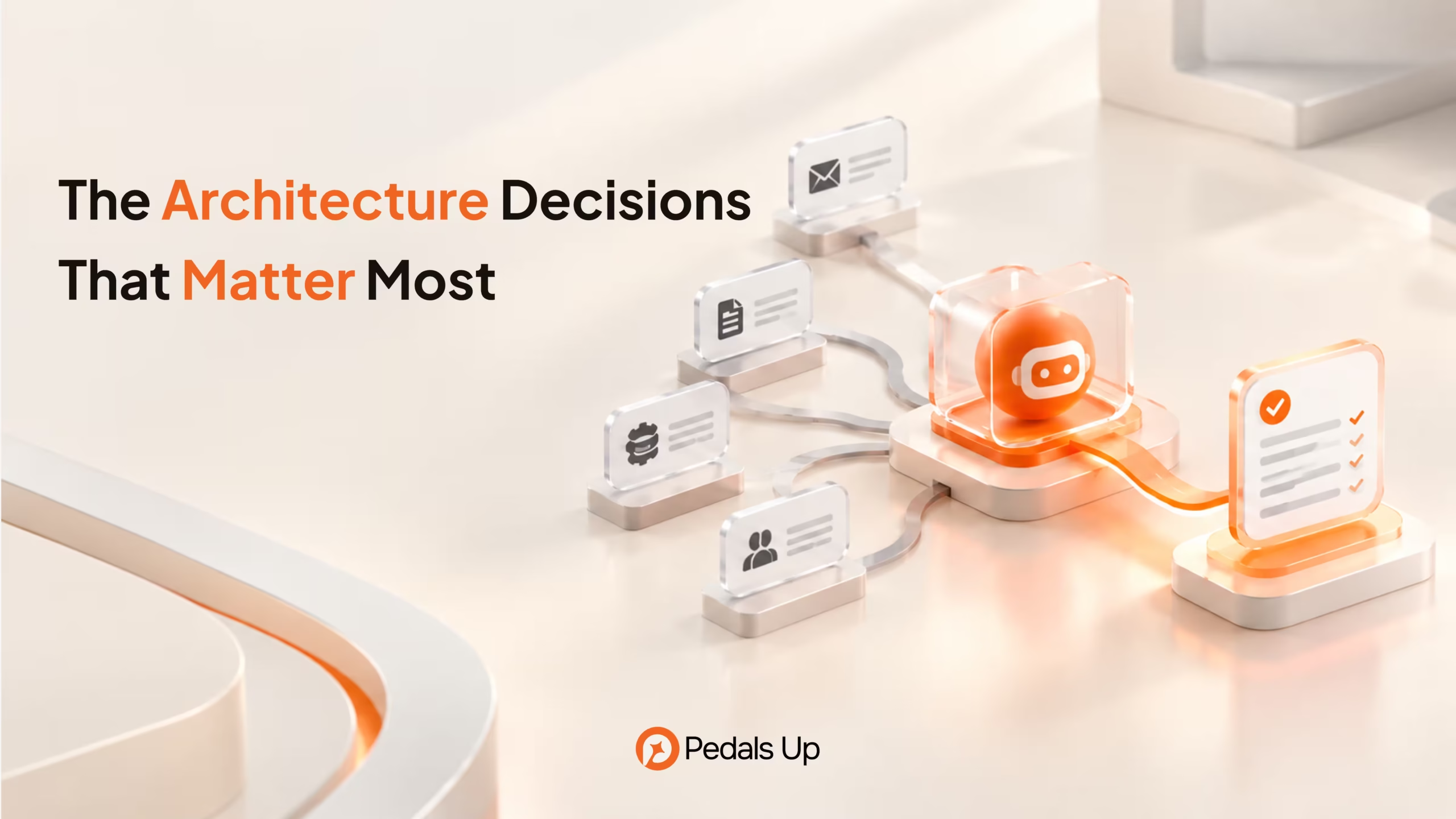
The Architecture Decisions That Matter Most
A task-specific agent can be relatively small while still demanding careful engineering. Four decisions usually determine whether it can move beyond a prototype.
Define the Operating Boundary
Document the trigger, expected input, authorized tools, required output, stopping conditions, and escalation rules. For a complaint investigation agent, specify whether it may retrieve order data, draft replies, open tickets, or change account records.
Treat this specification as an operational contract. Business owners define acceptable decisions; engineers implement the controls. If nobody can explain what a successful completion looks like, the scope is not ready.
Keep Data Access Proportional
Connect the agent to the information required for its task, not every system that might eventually prove useful. Separate read and write permissions, validate tool parameters, and keep sensitive actions behind server-side checks.
External documents and retrieved messages can contain misleading instructions. The system must treat that content as data, not as authority to override its operating rules. Audit logs should show which sources informed a decision and which actions were attempted.
Test Exceptions Before Expansion
Clean examples make impressive demos but weak evaluations. A production test set should include missing records, contradictory policies, malformed documents, expired permissions, and cases that genuinely require a person.
Track correct completions, unsupported claims, inappropriate tool calls, escalations, and recovery behavior. Test after changes to prompts, models, integrations, or policies. Reliability is not a one-time certification; it is an ongoing engineering responsibility.
Design for Failure and Recovery
Agents may time out, repeat actions, or receive partial results. Set execution limits, validate outputs, and make consequential operations idempotent where possible, so a retry cannot duplicate a payment or create multiple tickets.
Human approval is not evidence of poor automation. For high-impact decisions, it may be the control that makes automation economically and operationally viable.
The Hidden Cost of a General-Purpose Agent
Model usage is visible, but it is rarely the only cost worth examining. Integration maintenance, evaluation datasets, exception handling, monitoring, and policy updates can demand more sustained effort than an initial prototype.
General-purpose agents also accumulate dependencies. Every new tool expands the number of actions to secure and test. Overlapping tools can make selection harder, while broader permissions increase the consequences of an incorrect choice.
OpenAI’s practical agent-building guidance recommends maximizing a single agent’s capabilities before introducing multiple agents, and splitting responsibilities when complexity or tool confusion warrants it. That advice supports focused architecture, not the assumption that every narrow task requires a separate model or orchestration framework.
OpenAI
The stronger design is often one agent with a limited toolset, deterministic checks, and a clear handoff to people. Additional agents should solve an observed coordination problem, not satisfy an architectural preference.
How to Decide Whether the Investment Makes Sense
Start with a workflow whose baseline is already understood. Record current handling time, completion accuracy, review effort, exception rates, and the cost of mistakes. Then run the proposed agent against representative cases, including difficult ones.
Measure cost per accepted outcome rather than cost per model call. Include infrastructure, human review, corrections, and maintenance. An agent that handles easy cases quickly but sends difficult cases back without useful evidence may simply shift work instead of removing it.
A successful pilot should justify its next level of authority. That might mean moving from drafting responses to sending low-risk replies, or from flagging invoice discrepancies to updating an approved reconciliation status. Each expansion deserves its own evaluation.
Build Around the Work, Not the Promise of Autonomy
Task-specific AI agents make business sense when a narrow responsibility creates measurable value and limits operational exposure. Their advantage is not that they behave like general employees. It is that teams can define their work, verify the result, and control the consequences of failure.
For companies evaluating AI automation, the most productive first step is often an architecture review of one real workflow. PedalsUp helps businesses assess those tradeoffs and engineer AI systems around existing products and operations. Explore our AI agent development and product engineering services before committing to a larger rollout.
The goal is not to deploy the most autonomous system possible. It is to complete valuable work reliably enough that the business can depend on it.